If you’re asking how long SEO takes, you’ve probably already been burned by a vague answer. “It depends” is true, but it doesn’t help you plan a budget or decide whether to start.
Here is the straight answer: for most small businesses, SEO starts producing noticeable results in 4 to 6 months, and meaningful lead growth usually arrives between months 6 and 12. This post explains what happens in each phase, what makes the timeline shorter or longer, and how to tell whether your SEO is working before the big results show up.
We’ll also be blunt about something most agencies avoid: anyone promising page-one rankings in 30 days is either targeting a keyword nobody searches for or setting you up for disappointment.
The Short Answer: 4 to 12 Months
Google’s own guidance says that SEO changes typically take anywhere from four months to a year to show their full effect. Our experience with small business sites lines up with that range.
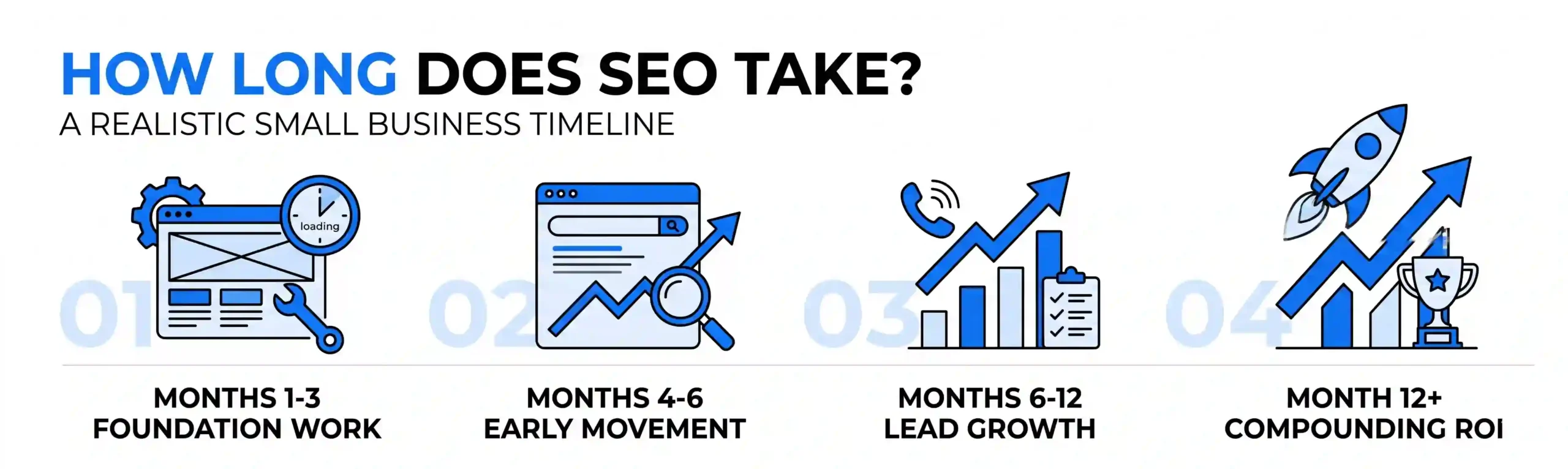
- Months 1-3: Foundation work. Rankings barely move.
- Months 4-6: First real movement. Impressions and clicks climb.
- Months 6-12: Leads and revenue start to follow the rankings.
- Month 12 onward: Growth compounds, and each new page builds on the last.
SEO is slow because Google needs time to find your changes, test them against competitors, and decide whether your site deserves more trust. You can’t speed up that judgment, but you can avoid delaying it.
What Actually Happens Month by Month
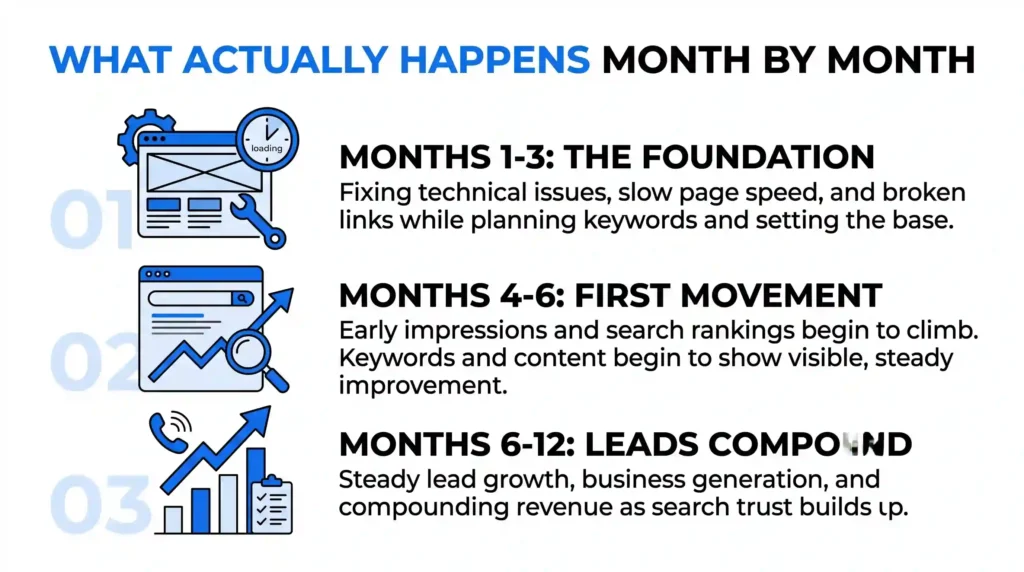
Months 1-3: Foundation (Little Visible Change)
This phase feels quiet, and that’s normal. The work here is fixing technical problems, such as slow page speed, broken links, and pages Google can’t properly read. It also covers keyword research, cleaning up your Google Business Profile, and fixing weak titles and descriptions on existing pages.
Expect small signs of life: more pages indexed and a few long-tail keywords creeping onto page two or three. If someone shows you a chart of big traffic gains this early, ask what they measured.
Months 4-6: First Movement
New and improved content has had time to be crawled and evaluated. Pages start climbing, and impressions (how often you appear in search results) rise noticeably. You’ll likely see some low-competition keywords reach page one.
Picture a local plumbing company that publishes proper service pages for “water heater repair” and “drain cleaning” in its city. In month two, those pages sit on page four. By month five, several have moved to the bottom of page one, and the phone starts ringing a few more times a week. That’s typical: modest at first, then steady.
Months 6-12: Leads Start Compounding
This is where SEO begins to pay for itself. Your pages have earned some trust, you’ve picked up relevant links, and you’re ranking for more commercial keywords, the ones people search right before they buy or book.
Growth in this phase usually isn’t a straight line. You’ll see jumps after Google updates and plateaus in between. Judge progress quarter over quarter, not week to week.
What Makes SEO Faster or Slower?
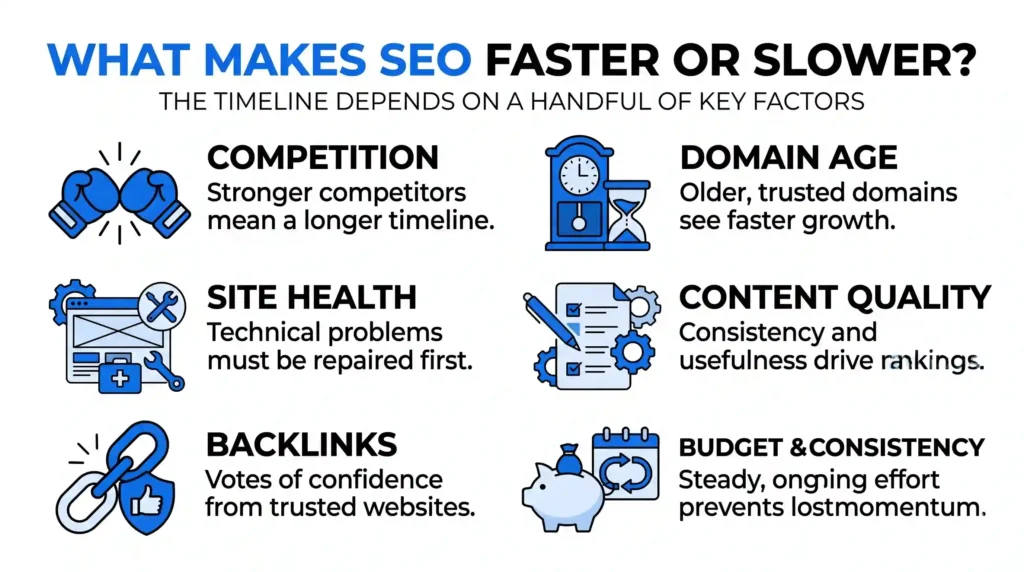
The timeline stretches or shrinks depending on a handful of factors. Be honest about where you stand on each.
- Competition: Ranking for “dentist in a small town” is far quicker than “best CRM software.” More competitors means more time.
- Domain age and history: A site that’s been live for five years with clean history starts ahead of a brand-new domain.
- Current site health: A site with technical problems needs repairs before growth work can pay off.
- Content volume and quality: Publishing two thin posts a month won’t move anything. Consistent, genuinely useful content will.
- Backlinks: Links from trusted, relevant sites act as votes of confidence. Competitors with stronger link profiles take longer to catch.
- Budget and consistency: Stopping and starting resets momentum. SEO rewards steady effort.
Why Quick Results Usually Mean Bad SEO
Some tactics do produce fast rankings: buying cheap links, stuffing keywords, or publishing mass-produced pages. They also tend to end in a Google penalty, and recovering from one can cost more than doing it right the first time.
Our view is simple: fast SEO that collapses in six months is worse than slow SEO that lasts for years. If you need leads this month, run paid ads while your SEO builds. The two work well together, and ads cover the gap.
How Do You Know It’s Working Before the Leads Arrive?
You don’t have to wait a year in the dark. Track these leading indicators from month two or three:
- Impressions in Google Search Console: Rising impressions mean Google is showing you to more people.
- Number of keywords ranking in the top 20: More keywords on pages one and two shows growing visibility.
- Average position: Gradual improvement on target keywords is the clearest early signal.
- Clicks from search: These follow impressions, usually with a lag of a month or two.
- Calls and form fills from organic traffic: The final measure, and the slowest to move.
If none of these have improved after six months of consistent work, something is wrong with the strategy, and that’s the time to ask hard questions.
The Bottom Line
SEO takes about 4 to 6 months to show movement and 6 to 12 months to deliver real business results. The businesses that win are the ones that start early, stay consistent, and measure the right things along the way.
Not sure where your site stands today? Nuclay will review your website, your competitors, and your biggest ranking opportunities, and give you a realistic timeline for your market. Request your free SEO audit and find out what’s holding your rankings back.
Frequently Asked Questions (FAQ)
Can SEO work in 30 days?
SEO rarely produces meaningful traffic or leads in 30 days. You may see technical improvements and a few ranking shifts, but Google needs several months to evaluate and trust new content. Claims of guaranteed first-page rankings in a month should be treated as a red flag.
How long does local SEO take compared to regular SEO?
Local SEO often shows results faster, commonly within 2 to 4 months, because local searches have fewer competitors. Optimizing your Google Business Profile and collecting reviews can bring visibility gains earlier than a national content strategy would.
Why is my SEO taking so long to work?
The usual causes are strong competition, a new or low-authority website, technical errors, thin content, or too few quality backlinks. Inconsistent effort also slows progress. A professional SEO audit can pinpoint which of these is holding your site back.
Is SEO worth it if it takes so long?
Yes, for most businesses planning to operate for more than a year. Unlike paid ads, which stop the moment you stop paying, SEO traffic keeps arriving after the work is done, and its cost per lead typically falls over time.