Every few months, another brand rolls out a slick AR filter or VR showroom, and small business owners start asking the same question: should we be doing this too? The honest answer is: sometimes, but not always, and definitely not the way most people assume.
AR/VR marketing for small businesses isn’t a single decision – it’s a spectrum. A furniture shop letting customers “place” a couch in their living room via phone camera is a completely different investment than building a full virtual reality showroom. One might pay for itself in a month. The other might sit unused after launch.
This post breaks down where AR and VR marketing actually work for small businesses, where they’re a waste of budget right now, what they realistically cost, and how to test the idea cheaply before committing real money.
What AR and VR Marketing Actually Look Like
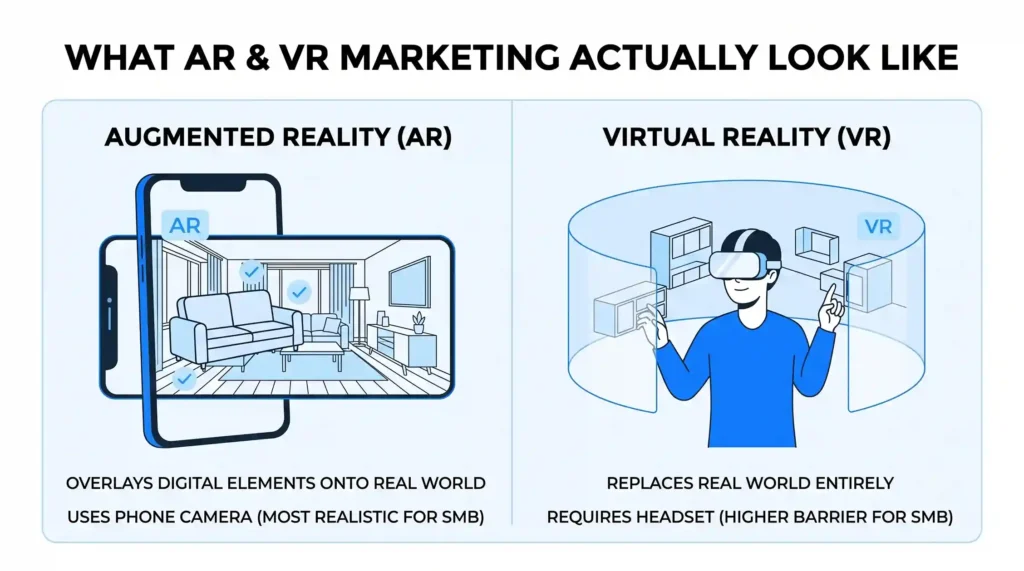
These two terms get used interchangeably, but they’re not the same thing, and mixing them up leads to bad budget decisions.
AR (Augmented Reality) overlays digital elements onto the real world through a phone camera or app. Think Instagram filters, or the IKEA Place app that lets you see how a couch looks in your actual living room before buying.
VR (Virtual Reality) replaces the real world entirely, usually through a headset. It’s fully immersive – think a virtual property tour where you “walk through” a house that doesn’t exist yet.
For most small businesses, AR is the more realistic entry point. It runs on a phone people already own. VR usually requires a headset most of your customers don’t have, which immediately narrows who can even experience what you built.
Where AR/VR Marketing Is Already Working for Small Businesses
This isn’t theoretical – there are specific categories where it’s already earning its keep:
- Retail with a visual product. Furniture, home decor, eyewear, and clothing brands use AR “try before you buy” tools to cut return rates and reduce buyer hesitation. Shopify’s own AR-enabled product listings have shown measurably higher conversion rates than static images for exactly this reason – customers convert faster when uncertainty is removed.
- Real estate and rentals. A 360-degree or VR walkthrough lets out-of-town buyers or renters tour a property without physically visiting, which shortens the sales cycle for [Client name]-style local agencies.
- Local services with a “before/after” story. Landscaping, renovation, and salon businesses use AR filters to preview outcomes – what a lawn, kitchen, or hairstyle could look like – which turns a vague pitch into something tangible.
The common thread: the product or outcome is visual, and uncertainty about “what will this actually look like” is what’s stopping the sale.
Where It’s Still a Waste of Budget
This is the part most agencies won’t tell you straight, so we will.
If you sell a service that isn’t visual – accounting, legal, consulting, most B2B software – AR/VR marketing isn’t solving a problem your customers actually have. Nobody’s sitting on the fence about hiring a bookkeeper because they can’t visualize a spreadsheet in 3D.
It’s also premature for businesses still building basic traffic and conversion. If your website isn’t converting the visitors you already get, an AR experience won’t fix that – it’ll just be an expensive distraction sitting on top of an unsolved problem.
Our position: AR/VR marketing should follow demand, not create it. Build it because customers are already asking “what will this look like,” not because a competitor has one.
The Real Cost of Getting Started
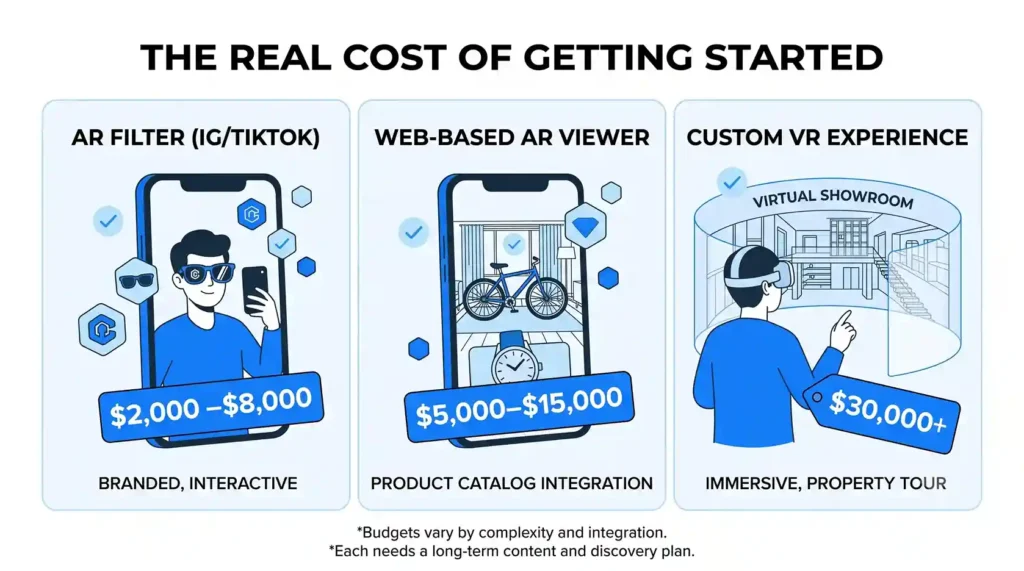
Budgets vary widely, but here’s a realistic range for small businesses in 2026:
- A branded AR filter for Instagram or TikTok: roughly $2,000–$8,000, depending on complexity.
- A web-based AR product viewer (like Shopify AR Quick Look integration): often $5,000–$15,000 to set up properly across a product catalog.
- A custom VR experience (property tour, branded showroom): typically $30,000+, plus hosting and headset compatibility considerations.
None of these are “set it and forget it.” Each needs a plan for how customers will actually discover and use it – otherwise it’s a well-produced piece of content nobody sees.
A Cheaper Way to Test the Waters First
Before committing five figures to a custom build, there’s a lower-risk path:
- Use existing AR tools built into platforms you already have – Instagram/TikTok filters, Shopify’s AR Quick Look, or Google’s free 360 Street View tool for a location-based business.
- Run it for 60–90 days and track a specific metric: return rate, time-on-page, or filter engagement.
- If it moves the number, scale into a more custom, owned experience. If it doesn’t, you’ve spent hundreds instead of thousands finding that out.
This is the approach we recommend to almost every small business client asking about AR/VR: prove the demand cheaply first, then build.
Should You Actually Do This?
AR/VR marketing isn’t a trend to chase just because it’s available – it’s a tool that fits a specific problem: customers who can’t quite picture the outcome before they buy. If that’s your business, it’s worth testing on a small budget first. If it isn’t, your money is better spent elsewhere for now.
If you’re not sure which camp you fall into, that’s exactly the kind of call worth talking through before you spend anything. Talk to our team – we’ll give you a straight answer, not a sales pitch for a build you don’t need.
Is AR/VR Right for Your Business?
Stop guessing your tech budget. Connect with the Nuclay team for an honest strategy call before spending a dime.
Talk To Our TeamFrequently Asked Questions (FAQ)
How much does AR/VR marketing cost for a small business?
A basic AR filter typically runs $2,000–$8,000. A web-based AR product viewer is usually $5,000–$15,000. A custom VR experience starts around $30,000. Costs scale with how custom and interactive the experience is.
Do I need an app for AR marketing, or can it work in a browser?
Most small business AR today runs through existing apps (Instagram, TikTok, Snapchat) or the browser via WebAR - no separate app download required. That's a major reason AR is more accessible than VR right now.
Is VR marketing worth it if I don't have a physical product?
Usually not yet. VR's strongest small business use cases are spatial - real estate, venues, physical locations. If there's nothing spatial to "walk through," the cost rarely justifies the return.
What's the easiest way to try AR marketing without a big budget?
Start with a free or low-cost platform-native tool - an Instagram filter or Google 360 tour - and measure engagement before investing in anything custom-built.