Every business we talk to says they want “to do more with AI.” Almost none of them can answer the follow-up question: ready to do what, exactly, and with what data?
That gap is the actual problem. Not a lack of AI tools – there are thousands. The problem is most businesses try to bolt AI onto a marketing operation that isn’t structured to use it well: messy customer data, no clear use case, no one owning the rollout. The result is a chatbot nobody trained properly, or a “content AI” that produces generic copy nobody wanted in the first place.
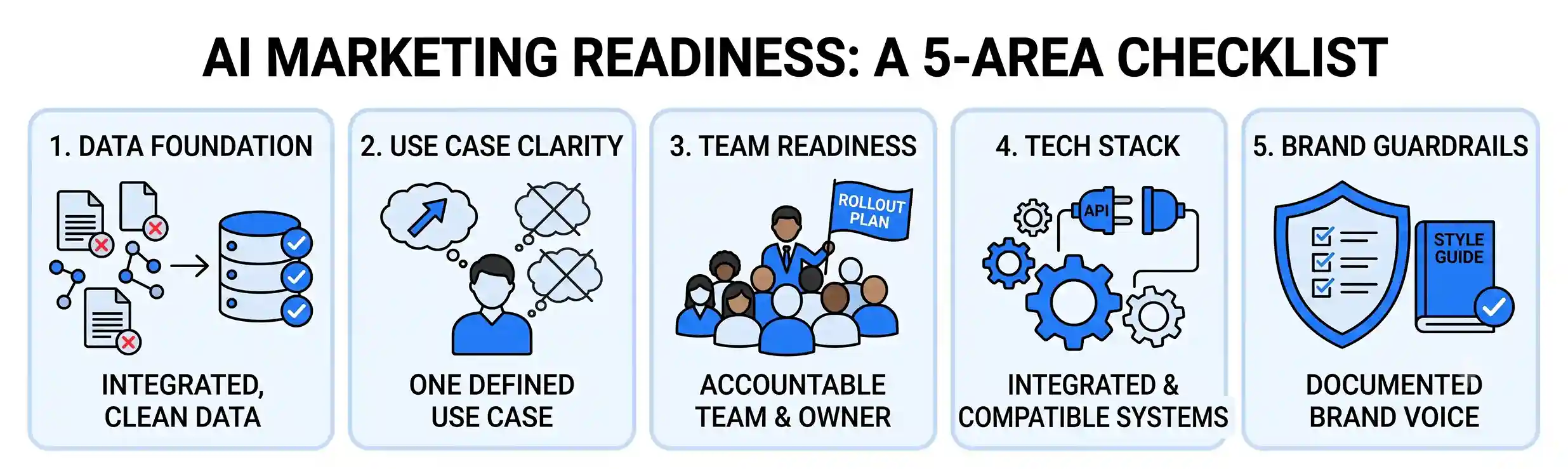
Below is the AI Marketing Readiness Checklist we use with clients before recommending any AI build. It’s a 10-minute self-audit across five areas that actually determine whether AI will work for your business – not a generic “10 AI trends” listicle. Score yourself as you go.
Why We Built This Instead of Just Pitching CustomGPT
We could have skipped the checklist and gone straight to “hire us to build you a custom AI chatbot.” We didn’t, because half the businesses that come to us asking for a CustomGPT solution aren’t actually ready for one yet – their data isn’t clean enough, or they don’t have a specific use case, and a chatbot built on that foundation underperforms no matter how good the build is.
This pattern shows up constantly in discovery calls. A business will say their customer data is “basically fine,” and then it turns out purchase history lives in the e-commerce platform, support tickets live in a separate helpdesk tool, and email engagement lives in a third system that’s never been connected to either. None of those systems talk to each other. An AI chatbot layered on top of that setup doesn’t fail because the AI is bad – it fails because it’s working with a third of the picture. Businesses that catch this before building anything save themselves a rebuild later.
That’s what this checklist is for: catching the gap before you spend on tools or a build.
How to Score It
Each section below has 4-5 questions. Rate yourself honestly from 1 (not at all) to 5 (fully in place) on each question, then add up your total for that section. At the end, you’ll total every section for an overall readiness score out of 100.
Section 1: Data Foundation
AI is only as good as the data it learns from. This section tells you whether your data is actually usable.
- Is your customer data centralized in one system, or spread across multiple disconnected tools?
- Can you pull a complete view of a single customer’s history in under five minutes?
- Is your data reasonably clean, with minimal duplicates or outdated records?
- Do your marketing, sales, and support tools share data with each other?
- Is someone responsible for maintaining data quality on an ongoing basis?
If you scored low here: don’t build anything yet. Fixing fragmented or messy data first – even something as simple as connecting your CRM and helpdesk tool – will do more for AI performance than any amount of prompt engineering later.
Section 2: Use Case Clarity
“We want to use AI” isn’t a use case. This section checks whether you actually have one.
- Can you name one specific process AI should improve first?
- Do you know what success looks like for that use case in measurable terms?
- Have you ruled out at least one AI use case as not worth pursuing yet?
- Is this use case tied to a real cost or revenue problem, not just a “nice to have”?
- Would solving this use case free up meaningful time or budget elsewhere?
If you scored low here: pick one process – usually the one costing your team the most hours or losing the most leads – and start there. Trying to solve five problems with one AI tool is how most rollouts stall.
Section 3: Team and Process Readiness
Tools don’t fail on their own. They fail when no one owns them.
- Is someone directly accountable for AI initiatives at your company?
- Does your team have bandwidth to test and refine an AI tool, not just launch it?
- Is there a plan for training staff on any new AI-powered workflow?
- Has leadership agreed on what “success” looks like before rollout begins?
If you scored low here: assign ownership before you assign budget. An AI tool with no one responsible for tuning it will quietly stop being used within a few months, the same way most under-adopted software does.
Section 4: Tech Stack Compatibility
AI tools need somewhere to plug in. This section checks whether your current systems can actually support that.
- Does your CRM support API integrations with third-party tools?
- Is your website built on a platform that can support a chatbot or AI widget?
- Do you have technical support, in-house or through an agency, available if integration issues come up?
- Have you audited which of your current tools already offer built-in AI features you’re not using?
If you scored low here: this is often the fastest fix on the list. A quick audit of your CRM and website platform usually reveals whether you need new infrastructure or just need to turn on features you’re already paying for.
Section 5: Content and Brand Guardrails
If AI is going to write, respond, or represent your brand, it needs rules to follow. Most businesses haven’t written those rules down.
- Do you have documented brand voice guidelines an AI system could reference?
- Do you have examples of “on-brand” and “off-brand” content to train a tool against?
- Is there a review process in place for AI-generated content before it goes live?
- Have you defined topics or phrases an AI tool should never use on your behalf?
If you scored low here: this is quick to fix and easy to skip, which is exactly why most businesses skip it. A one-page brand voice doc with a few good and bad examples is often enough to keep AI-generated content from sounding generic.
What Your Total Score Means
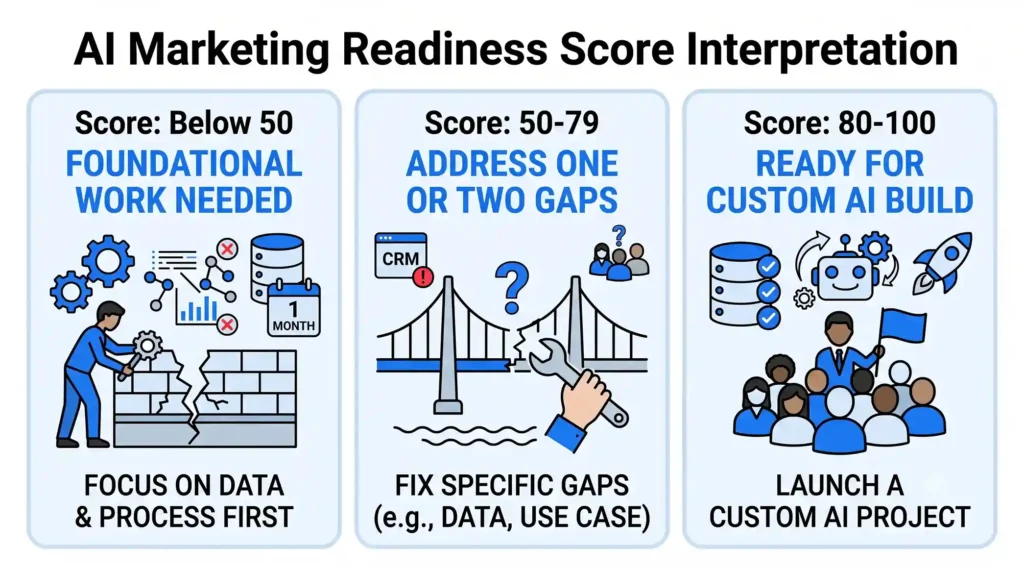
Add up your scores across all five sections for a total out of 100.
- 80-100: You’re ready to move on a custom AI build. Your data, use case, team, and tech stack are aligned enough that a project like a custom GPT or AI chatbot is likely to perform well from day one.
- 50-79: You have one or two gaps worth closing first. Most businesses land here – usually the data or use case section is the weak spot. Fix that specific gap, then move forward.
- Below 50: Foundational work is needed before AI tools will deliver a real return. That’s not a bad outcome, it’s useful information. Spend the next month on data and process, not on evaluating AI vendors.
Who This Checklist Is For
This is built for business owners and marketing leads who are past “should we even look at AI” and into “where do we actually start.” It’s useful whether you’re evaluating a custom AI chatbot for customer service or sales, AI-assisted content or campaign production, AI features layered into your existing CRM, or simply whether to build in-house versus bring in a partner.
Where to Go From Here
Your score isn’t a grade, it’s a map. If you landed in the 80-100 range, you’re in a strong position to move on a custom AI build without wasting time or budget. If you scored lower, you now know exactly which gap to close first, instead of guessing or buying tools that won’t perform on a shaky foundation.
Either way, you don’t have to figure out the next step alone. Talk to our team about your results and we’ll tell you plainly whether you’re ready to build, what to fix first if you’re not, and what that would actually involve.
Not Sure What Your Score Actually Means?
Skip the guesswork. Talk to the Nuclay team and get a clear answer on whether you’re ready to build or what to fix first.
Get Your Results ReviewedFrequently Asked Questions (FAQ)
How do I know if my business is ready for AI?
Check five things: your customer data is centralized and clean, you have one specific process you want AI to improve, someone owns the rollout, your CRM and website can support integrations, and you've documented your brand voice. This checklist scores you across all five in about 10 minutes.
Why do most AI marketing tools fail to deliver results?
Usually not because the AI is bad - it's because it's built on fragmented data, a vague use case, or no one responsible for tuning it. A chatbot or content tool layered onto a messy foundation underperforms no matter how good the underlying model is.
What should I fix first if my score is low?
Start with data. A messy or fragmented customer data setup - like your CRM, helpdesk, and email tools not talking to each other - undermines every other AI initiative, so it's worth fixing before you pick a use case or evaluate vendors.
What if I score low across most sections?
That's useful information, not a bad outcome. It means AI tools aren't the right first investment yet - fixing your data foundation or defining a clear use case is. The checklist tells you which of those to prioritize instead of guessing.