If you’ve heard the term “CustomGPT” thrown around and assumed it’s just ChatGPT with a different logo, you’re not alone – and you’re not entirely wrong, but you’re missing the important part. A CustomGPT is an AI assistant trained specifically on your business information, so it can answer questions, handle support tickets, or guide customers using facts about your company instead of generic internet knowledge.
That distinction matters more than it sounds like it should. A regular chatbot might tell a customer something plausible but wrong. A CustomGPT tells them what’s actually true about your return policy, your product specs, or your pricing tiers – because it was built on those exact documents.
This guide breaks down what a CustomGPT actually is, how it works under the hood (without the engineering jargon), and how to tell if your business is a good fit for one.
What Does “CustomGPT” Actually Mean?
“GPT” stands for Generative Pre-trained Transformer – the underlying technology behind tools like ChatGPT. “Custom” means the AI has been fed your specific content: your website, your FAQ pages, your internal wikis, your product manuals, even your past support tickets.
The result is an assistant that speaks with your company’s voice and knows your company’s facts, rather than a general-purpose bot pulling from the entire internet. Ask a stock ChatGPT about your refund window and it’ll guess or refuse. Ask a CustomGPT and it’ll tell you exactly what your policy says, because it was trained on the policy itself.
How Does a CustomGPT Actually Work?
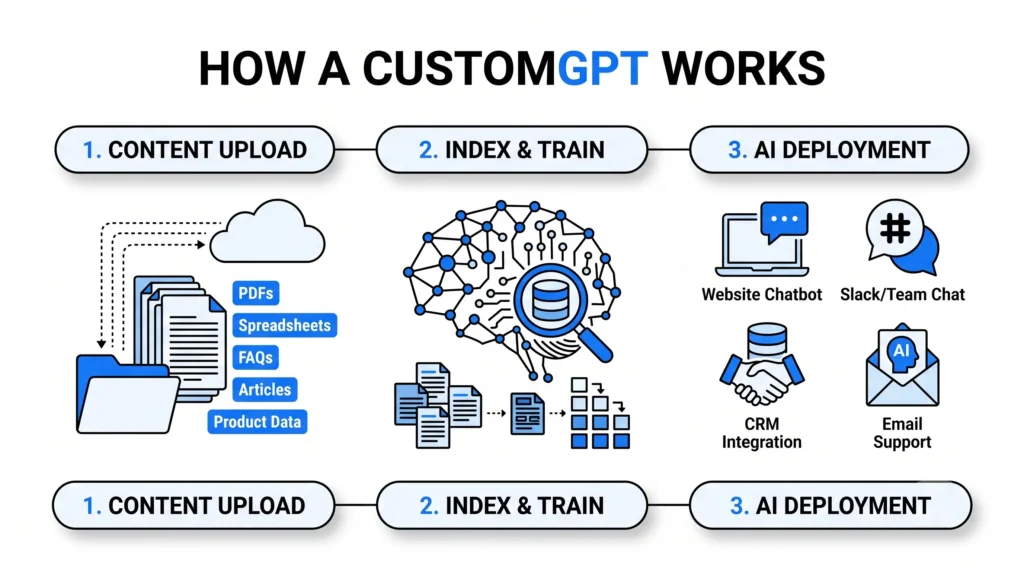
At a basic level, three things happen:
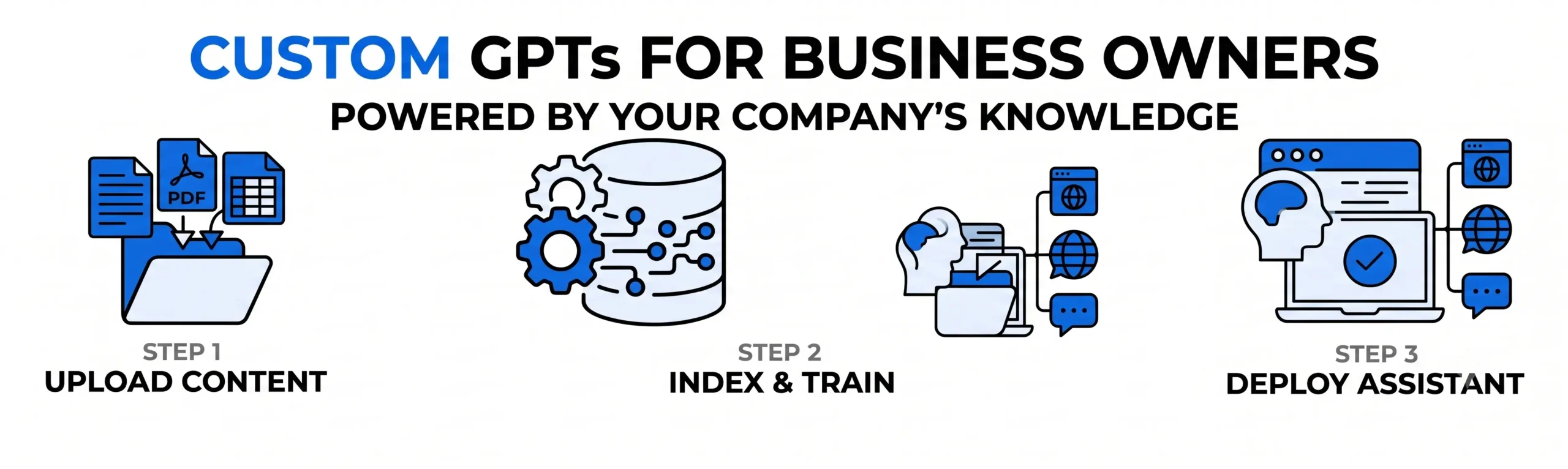
- Your content gets uploaded. PDFs, help center articles, spreadsheets, product data – whatever information the AI needs to know.
- That content gets indexed. The system breaks it into searchable chunks so the AI can pull the right facts at the right moment instead of relying on memory alone.
- The AI gets deployed. It shows up wherever you need it – embedded on your website, inside a Slack channel, connected to your CRM, or answering emails.
Here’s a concrete example: a mid-sized SaaS company with a 40-page product documentation site can turn that entire site into a CustomGPT in roughly a week. Instead of customers digging through docs, they type a question and get a direct answer, sourced from the actual documentation, in seconds.
What Can a CustomGPT Do for Your Business?
This is where most of the confusion clears up, because the use cases are pretty concrete:
- Customer support – Answering common questions instantly, 24/7, without a human touching every ticket
- Sales enablement – Reps can ask “what’s our pricing for enterprise clients with 500+ seats?” and get an instant, accurate answer
- Internal knowledge management – New hires ask HR policy questions instead of hunting through a shared drive
- Lead qualification – A website assistant that asks the right questions and routes serious prospects to a human
One agency client used a CustomGPT trained on their onboarding documentation and cut new-employee ramp-up questions to their HR team by [X%] within the first month. That’s not a hypothetical – that’s the kind of measurable time savings this technology is built for.
CustomGPT vs. a Generic Chatbot: What’s the Real Difference?
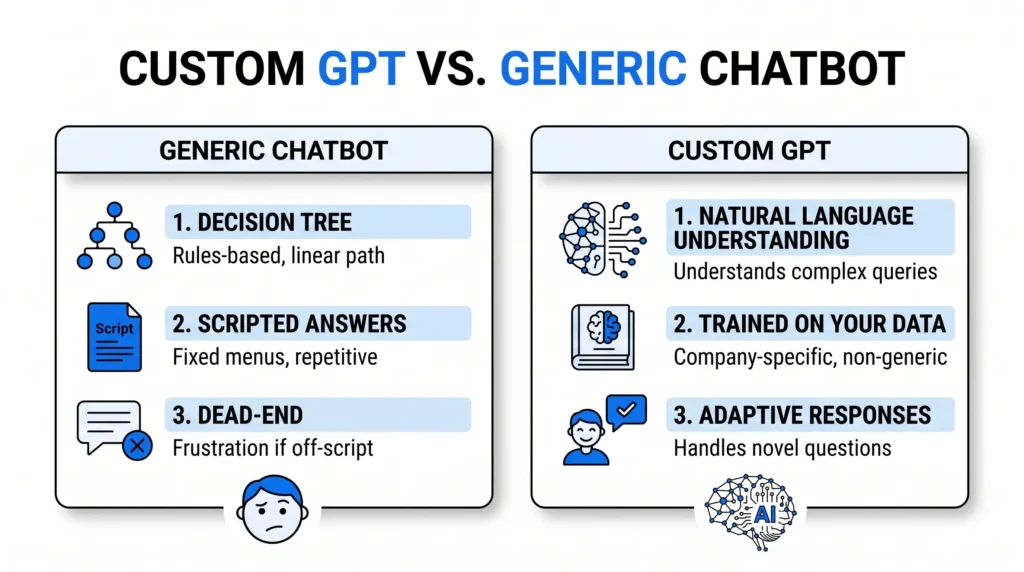
We’ll be blunt: most “chatbots” businesses installed five years ago are decision trees. Click a button, get a scripted response, hit a dead end if your question isn’t on the list. They’re not really AI – they’re glorified FAQ menus.
A CustomGPT actually understands the question you’re asking, even if you phrase it in a way the business never anticipated. That’s the entire point of using a language model instead of a rules-based bot. If your current chatbot frustrates customers because it can’t handle anything outside a rigid script, that’s a sign you’ve outgrown it – not a sign that AI assistants don’t work.
Who Actually Needs One?
Not every business does, and we’d rather tell you that upfront than sell you something you don’t need. A CustomGPT makes the most sense when:
- You get a high volume of repetitive questions (support tickets, sales inquiries, HR requests)
- You have a meaningful amount of existing documentation to train it on
- Your team is spending real hours answering the same handful of questions over and over
If you’re a five-person business answering a dozen emails a week, a CustomGPT is overkill – a well-written FAQ page will do the job. If you’re fielding hundreds of repetitive questions a month across support, sales, or internal teams, the math starts to favor automation fast.
What It Costs and Takes to Build One
Timelines and budgets vary depending on how much content you’re working with and how deeply the assistant needs to integrate with your existing tools (CRM, help desk, website). A straightforward version – trained on existing documentation and embedded on a website – can often be live within a few weeks. More complex builds, like ones that pull live data from a CRM or trigger workflows, take longer and cost more.
The honest answer is: it depends on your setup, and any agency that gives you a firm number before looking at your actual content and systems is guessing.
The Bottom Line
A CustomGPT isn’t a buzzword – it’s a practical tool for businesses drowning in repetitive questions, whether those questions come from customers, sales prospects, or your own employees. The technology is accessible enough now that it’s not just a Fortune 500 play anymore.
If you’re curious whether a CustomGPT fits your business, take a look at our CustomGPT service page to see how we approach building one – no obligation, just a clearer picture of what it could look like for you.
Tired of Answering the Same Questions?
Stop losing hours to repetitive support tickets and FAQs.
Build a CustomGPT that knows your exact business policies.
Build the future with Nuclay Solutions.