
data privacy – Your One Stop Digital Solution

data privacy

LLM & AI Chatbot, Technology, Trends

The Clean Code Mandate: Solving Tech Debt

“We’ll fix it later.” In software development, “later” is the most expensive word in the dictionary. When you rush a feature to market by taking shortcuts, you aren’t just saving time, you are taking out a high-interest loan. In the tech world, we call this Tech Debt. By 2026, many businesses are finding that their “loan” has come due. If your development team is moving slower than they were a year ago, or if simple updates now cause massive system crashes, you are likely drowning in unmanaged debt. You aren’t lacking talent; you are lacking a clean foundation. Why Tech Debt Happens Tech Debt isn’t always caused by bad engineers; it’s usually caused by speed. When a business prioritizes a deadline over structural integrity, developers write “quick and dirty” code to bridge the gap. While this might help you launch on time, it creates a “fragility” that compounds every time you add a new layer. The result is “Spaghetti Code”: The Clean Code Standard Clean Code is the practice of writing software that is self-explanatory, organized, and modular. Think of your software like a warehouse: Tech Debt is throwing boxes on the floor just to get them inside faster. Clean Code is putting them on labeled, accessible shelves. How we solve it: Moving From Maintenance to Innovation The true cost of Tech Debt isn’t just the bugs it’s the opportunity cost. Most legacy businesses spend 80% of their IT budget just “keeping the lights on” and fixing old errors. That leaves only 20% for the innovative features that actually grow the business. By enforcing the Clean Code Mandate, we flip that ratio. Across 80+ projects, we’ve seen that cleaning the “core” of a system allows teams to move 3x faster. You stop being a “Digital Janitor” cleaning up past messes and start being an “Architect” building the future. When your foundation is clean, your developers spend their time building new tools for your customers rather than chasing ghosts in the machine. Building Tech Equity Your software should be a strategic asset that gains value over time, not a liability that drains your bank account. If your current system feels like an anchor holding you back from the AI revolution, it’s time to settle the debt. At Nuclay Solutions, we specialize in identifying the specific “bottlenecks” in your architecture, the 20% of your code causing 80% of your headaches and refactoring them into a clean, AI-ready engine. We help you transition from fragile legacy systems to a scalable, modern stack. Is your code holding you back? Don’t let old tech slow you down. We turn messy legacy systems into modern, AI-ready engines. Modernize My Stack Build the future with Nuclay.
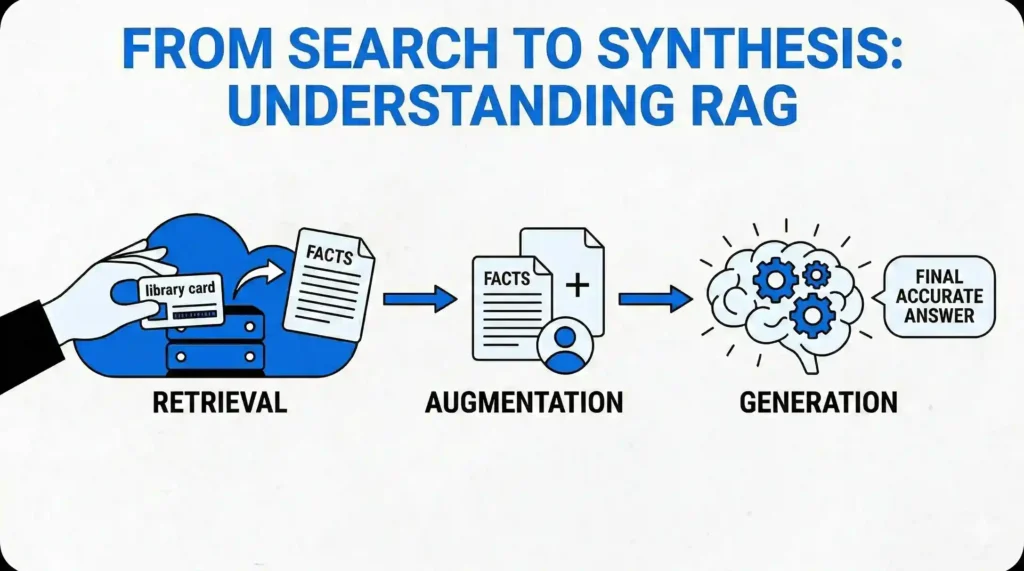

Stop AI hallucinations. Learn how Retrieval-Augmented Generation (RAG) connects a generative "Brain" to your private "Source of Truth" for 100% accurate, safe, and real-time AI insights.
LLM & AI Chatbot, Trends

Understanding RAG from Scratch

Have you ever asked a standard AI a specific question about your company, only for it to give you a confident but completely wrong answer? In the tech world, we call that a “hallucination.” It happens because most AI models are trained on the public internet, not on your private business data. To solve this, we use a breakthrough architecture called RAG (Retrieval-Augmented Generation). It is the difference between an AI that “guesses” and an AI that “knows.” How RAG Works Imagine you hire a brilliant assistant who has read every book in the world but has never stepped foot inside your office. If you ask them, “Who was our top donor last year?” they will try to guess based on general information. That is a standard AI. RAG changes the game by giving that assistant a library card to your private archives. When you ask a question using RAG: Why RAG is the Gold Standard for 2026 In 2024, businesses were afraid to use AI because they couldn’t trust the output. In 2026, RAG has eliminated that fear. By connecting a generative “Brain” to a verified “Source of Truth,” we ensure your AI remains both smart and safe. Here is why RAG is a non-negotiable for your business: Is Your Data “AI-Ready”? RAG is powerful, but it requires a clean “library” to work. If your data is scattered across old spreadsheets and messy folders, the AI will struggle to find the right books. Check your readiness: If you have the data, we have the “Library Card” technology to make it talk. The Nuclay Approach At Nuclay, we specialize in building these private “libraries” for our clients. We’ve delivered over 80 projects where we turn stagnant company data into active, synthesizable knowledge. We don’t just give you a chatbot; we give you a system that understands your business as well as you do. The era of “searching” for files is over. The era of “asking” your data is here.Stop Searching. Start Knowing. Is your company data working for you, or is it just sitting in a digital filing cabinet? Most businesses are sitting on a goldmine of information they can’t easily access. At Nuclay Solutions, we specialize in building the architecture that brings that data to life. Let’s discuss your current tech stack and explore how a custom RAG implementation can turn your internal documents into a massive strategic advantage. Stop Searching. Start Knowing. Don’t let your data sit in a digital filing cabinet.Build a private AI library that understands your business. Schedule Consultation Build the future with Nuclay Solutions. @media (max-width: 480px) { .nuclay-rag-cta { padding: 35px 15px !important; width: 95% !important; } }

Information

Have we learned anything since Cambridge Analytica?

In 2018, when Christopher Wiley blew the whistle, the world acknowledged for the first time, how their data could be used to manipulate their minds. Facebook profiles of 370,000 people were used to create a psychological strategy pertaining to more than 87 million profiles, 300 times the initial number, without their consent. The goal was to influence their votes with fake news and directional campaigns, and influence the US Presidential Election. The Cambridge Analytica (CA) and Facebook scandal might be the epitome of corruption in data usage. The end result was massive negative marketing against Facebook. #DeleteFacebook campaign trended all across the world. More than 26% American users deleted Facebook from their phones. But it was never just about the company and their work. Neither was it about one of the biggest companies in the world, overseeing a massive embezzlement below its nose. It was about businesses, including Facebook, taking more data from people than needed and giving away more than they should–often asking permissions in a hidden print–if at all.  It has been more than a year since the issue became a front page news in every newspaper. Yet, a year on, have we learned anything from what sparked the greatest privacy awakening? The biggest apparent outcome is that people seek control over their information. There is a feeling that companies can no longer be set free to regulate themselves and many states in the USA have started acting over it. Vermont implemented a law that had compelled data brokers to register with the state. In the coming January, California is implementing a law which will give residents the power to opt out of having their data sold. The Congress is deliberating over a federal data protection law. And it is not limited to just the United States. In February 2019, the UK parliament published a report based on testimonies from CA directors, Facebook executives and dozens of witnesses. It concluded that the Silicon Valley’s tech platforms were out of control, specifically pointing out to Facebook. Alongside the government bodies and agencies taking actions, users also became much aware online. According to a survey published by the Atlantic, around 80% of the people are concerned about their privacy over the internet, and around 83% say that they self-censor on social media. Herein, self-censorship has been defined as “stopping yourself from posting something you might otherwise want to share, because of concerns about privacy“. Around 10% of people reported deleting or deactivating their Facebook accounts.  Here are 5 key takeaways for users to keep their data safe online:  The internet is full of dishonest players.There are many legitimate-looking organisations that are waiting to phish your data and use it in any way that they want. If a software or application asks for your data, it must be transparent and unsuspicious to its purpose. It is essential to know what your data is being collected for, before you authorise its use. You can be easily mislead.Organisations that engage with communities need to be proactive and must state their privacy instructions clearly. Giving easy to understand guidelines is necessary to build trust. The whole system can be misused.The CA scandal is the biggest example of how outside influencers can manipulate information and influence decisions. Community engagement professionals need to be vigilant and must inspect the data that organisations gather for potential manipulation. If something looks out of the ordinary, it must be investigated further. Privacy must be an option.All users on a platform must ensure that there is a basic guarantee of privacy. It must be ensured that their data is safe, secure and not used for purposes other than the ones stated when the consent is given. The world is connected more than ever before.Many people in the world do not realise how much data is being generated on social media networks or how this data can be manipulated. Today, users are more engaged over the internet than ever. Whether its contacts from work or friends from school, many of us feel disconnected if we take ourselves from social media platforms for a while. It’s good to be on such platforms, but it is your prerogative to understand what information to share and what not to. As people spend a lot of time on the internet it is their responsibility to be safe. Yes, social media is a great source to disseminate information, but user discretion is advised.

Services

Get in touch

Gurugram Office

Dehradun Office

Scroll to Top