If you’ve typed a few prompts into ChatGPT and thought “could this run part of my business,” you’re not alone – and you’re not wrong to wonder. But there’s a real gap between using ChatGPT as a tool and building a CustomGPT: an AI chatbot trained specifically on your company’s own data, processes, and voice.
That gap matters more than most business owners realize until it costs them a deal, a compliance headache, or a customer’s trust. This post breaks down where ChatGPT genuinely holds up, where it starts to fall apart at business scale, and what you actually get when you invest in a custom-built alternative.
By the end, you’ll know which one fits where you are right now – not which one sounds more impressive in a sales pitch.
What ChatGPT Is Actually Built For
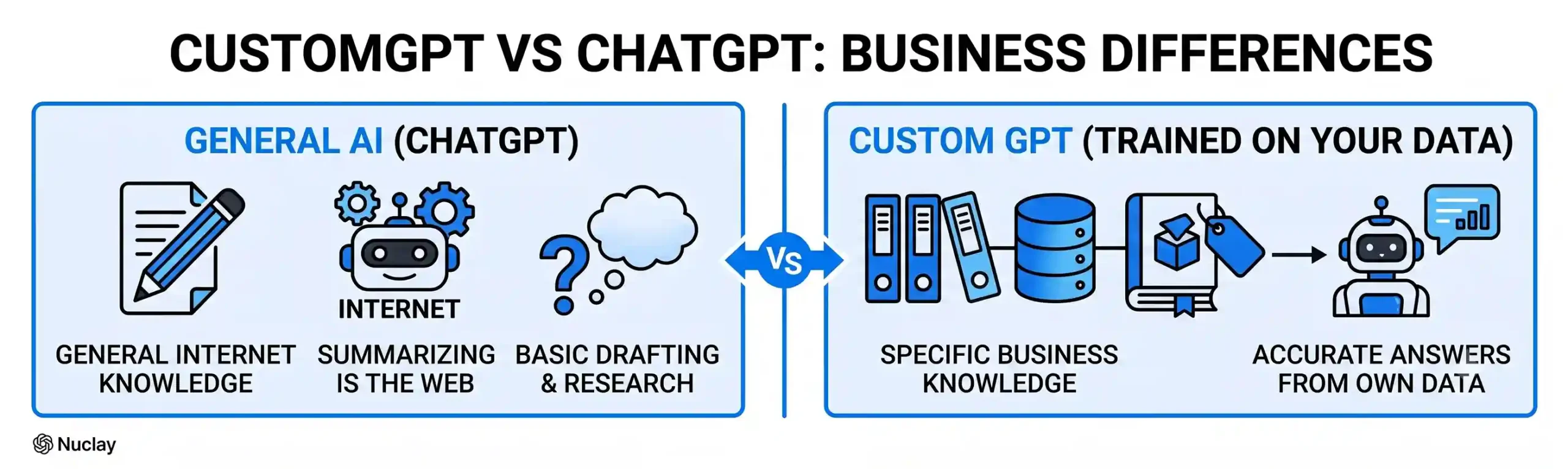
ChatGPT (the consumer and Plus/Team versions most businesses start with) is a general-purpose assistant. It’s trained on a broad slice of the internet, not your business. That makes it excellent at drafting emails, brainstorming, summarizing documents you paste in, or writing a first-pass blog post.
What it’s not built for: knowing your pricing tiers, your return policy, your product SKUs, or the answer to “what did we tell this customer last time they emailed support.” Ask it something specific to your business and it will either say it doesn’t know, or – more dangerously – guess confidently and get it wrong. That’s a hallucination, and it’s the single biggest reason companies stop letting ChatGPT touch customer-facing work.
What a CustomGPT Actually Is
A CustomGPT is a chatbot built on top of large language model technology (often the same underlying models that power ChatGPT) but trained on your data: your knowledge base, your CRM records, your product catalog, your support tickets. Instead of pulling from the open internet, it pulls from what’s actually true about your business.
Practically, this means a customer asking “do you ship to Canada” gets an answer from your actual shipping policy – not a plausible-sounding guess. It’s the difference between a smart intern who read the internet and an employee who’s read your internal wiki.
The Real Differences That Affect Your Business
Accuracy on Your Own Information
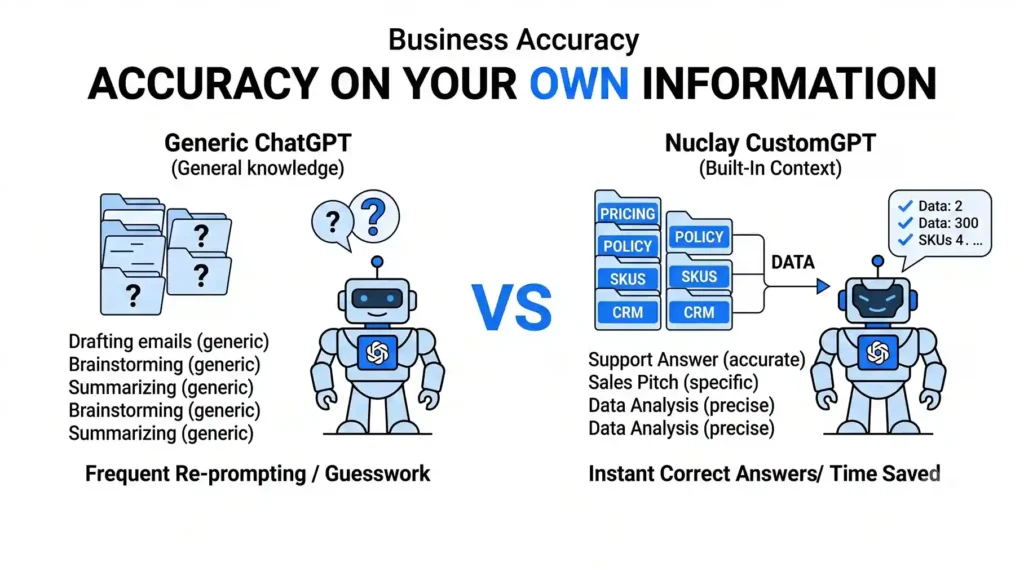
ChatGPT has no memory of your business unless you feed it context in every single conversation. A CustomGPT has that context built in permanently. For a support team fielding the same 40 questions a day, that’s the difference between a tool that saves time and one that creates more work double-checking its answers.
Data Privacy and Security
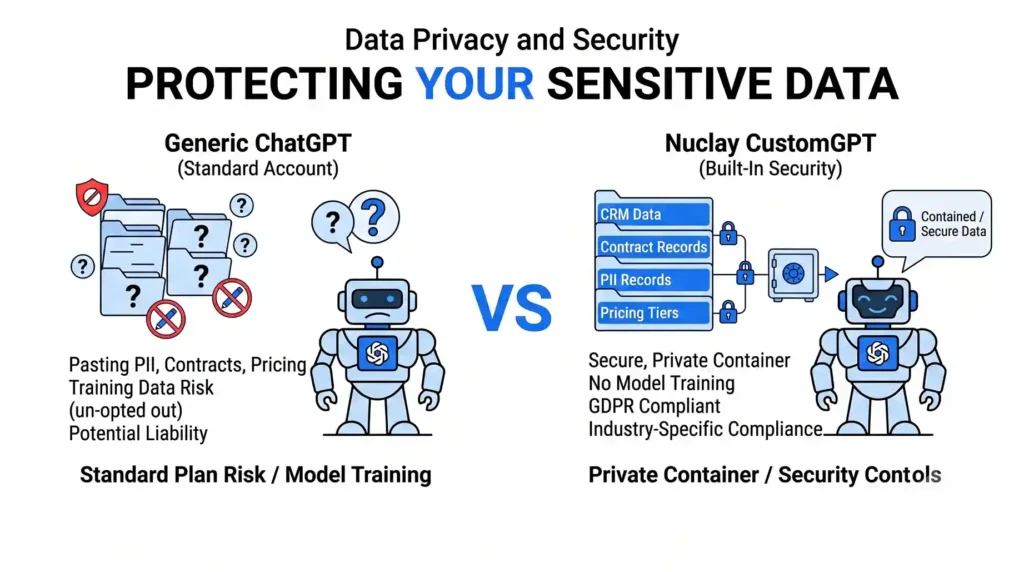
This is where a lot of companies get uncomfortable. Standard ChatGPT accounts aren’t built for handling sensitive customer data, contracts, or proprietary pricing – and depending on your plan, your inputs may be used to help train future models unless you’ve explicitly opted out. A CustomGPT, built properly, keeps your data contained, doesn’t train on it, and can be configured to meet requirements like GDPR or industry-specific compliance. If your team is pasting customer PII into ChatGPT to save time, that’s a liability sitting in plain sight.
Brand Voice and Control
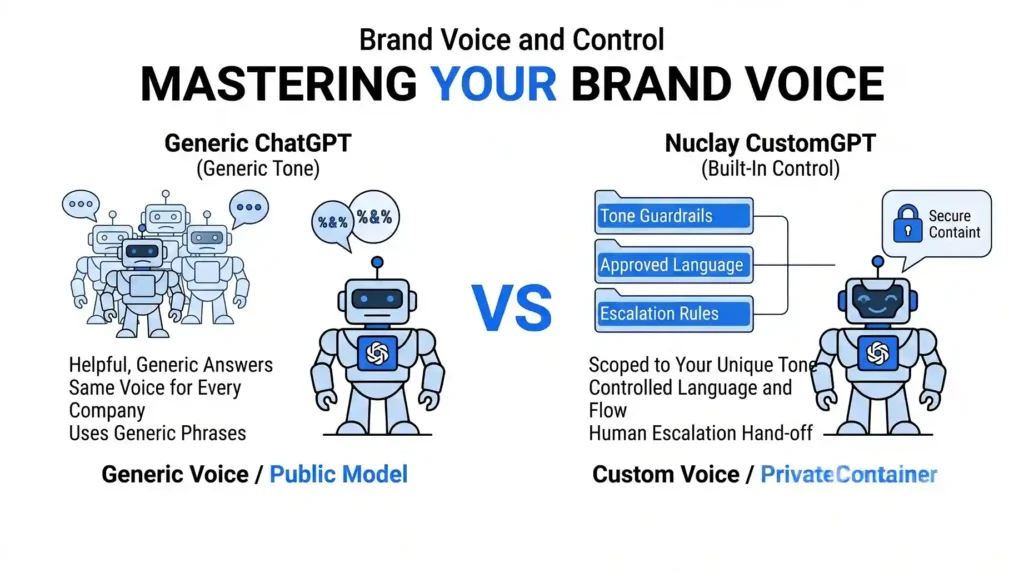
ChatGPT answers like ChatGPT – helpful, generic, and the same for every company using it. A CustomGPT can be scoped to only answer within your guardrails: your tone, your approved language, your escalation rules for when a human needs to step in. That control matters the moment this tool is talking to actual customers instead of just your team.
Cost
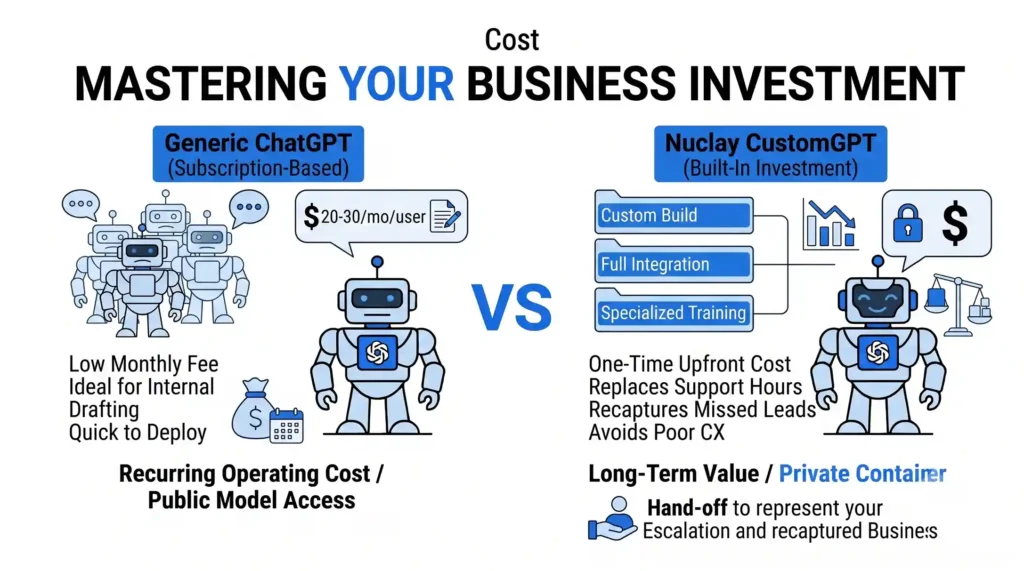
ChatGPT’s paid tiers run roughly $20–30 per user per month for individuals or small teams – cheap, and fine for internal drafting work. A CustomGPT is a bigger upfront investment because it’s built, trained, and integrated specifically for you, not a subscription. But it replaces work that would otherwise cost you in support hours, missed leads, or bad customer experiences from an assistant that doesn’t actually know your business.
When ChatGPT Is Genuinely Enough
We’re not going to pretend everyone needs a custom build – that’s not honest, and it’s not how we’d want a vendor to talk to us either. If you’re a small team using AI for internal writing, research, or brainstorming, and nothing customer-facing or sensitive touches it, ChatGPT Plus or Team is a perfectly reasonable tool. Don’t overbuy.
When You Need a CustomGPT Instead
The line gets crossed the moment AI starts talking to your customers, handling anything with personal data, or needing to know facts specific to your business that change how a conversation should go. At that point, generic ChatGPT isn’t a cost-saver – it’s a risk you’re carrying for free. That’s the point where an agency-built CustomGPT starts paying for itself in fewer support tickets, faster response times, and conversations that don’t require a human to clean up afterward.
The Bottom Line
ChatGPT is a good general tool. It was never built to be your business’s brain. If AI is going to touch your customers, your data, or your reputation, the gap between “generic assistant” and “trained on your business” is exactly where things go right – or wrong.
Want to know whether your business actually needs a CustomGPT, or whether ChatGPT is doing enough for now? Get a custom quote and we’ll tell you honestly, not just sell you the bigger build.
Is Generic ChatGPT Costing You Customers?
Stop guessing if you need a custom build. Get an honest assessment from Nuclay – a real recommendation, not a sales pitch.
Get Your Free QuoteFrequently Asked Questions (FAQ)
Can I just upload documents to ChatGPT instead of building a CustomGPT?
You can, but that context resets or gets limited depending on the plan and conversation length, and it doesn’t scale to multiple team members or customers using it at once. A CustomGPT keeps that knowledge live and accessible across every conversation, not just the one you happened to upload files into.
Is a CustomGPT more secure than ChatGPT for handling customer data?
When built correctly, yes. A CustomGPT can be configured so your data isn’t used for model training and stays within defined access controls, which standard ChatGPT plans aren’t designed to guarantee at the same level.
How long does it take to build a CustomGPT for a business?
It depends on scope – a narrow use case like FAQ support can move faster than a full CRM-integrated assistant. [X weeks] is a reasonable range for most mid-sized builds, though complexity is the real driver, not company size.
Can a CustomGPT replace my support team?
No, and we wouldn’t sell it that way. It handles the repetitive, answerable-from-data questions so your team can spend time on the conversations that actually need a person.