“We’ll get to SEO eventually” is one of the most expensive sentences a small business owner can say. Not because SEO is magic, but because every month it’s postponed, a competitor is quietly climbing the search results you’re not showing up in – and picking up the customers who would have found you instead.
This isn’t a post trying to scare you into buying SEO services. It’s a straight look at what “ignoring SEO” actually costs, in real numbers where we can get them, so you can decide with clear eyes instead of vague guilt.
By the end, you’ll know exactly where that cost shows up in your business – and the target keyword here, cost of ignoring SEO, is really a question of lost revenue, not lost rankings.
The Traffic You’re Not Getting Doesn’t Announce Itself
This is the core problem with skipping SEO: there’s no invoice for it. No alert says “you lost 40 potential customers this month.” The cost is invisible because it’s made of people who never found you in the first place.
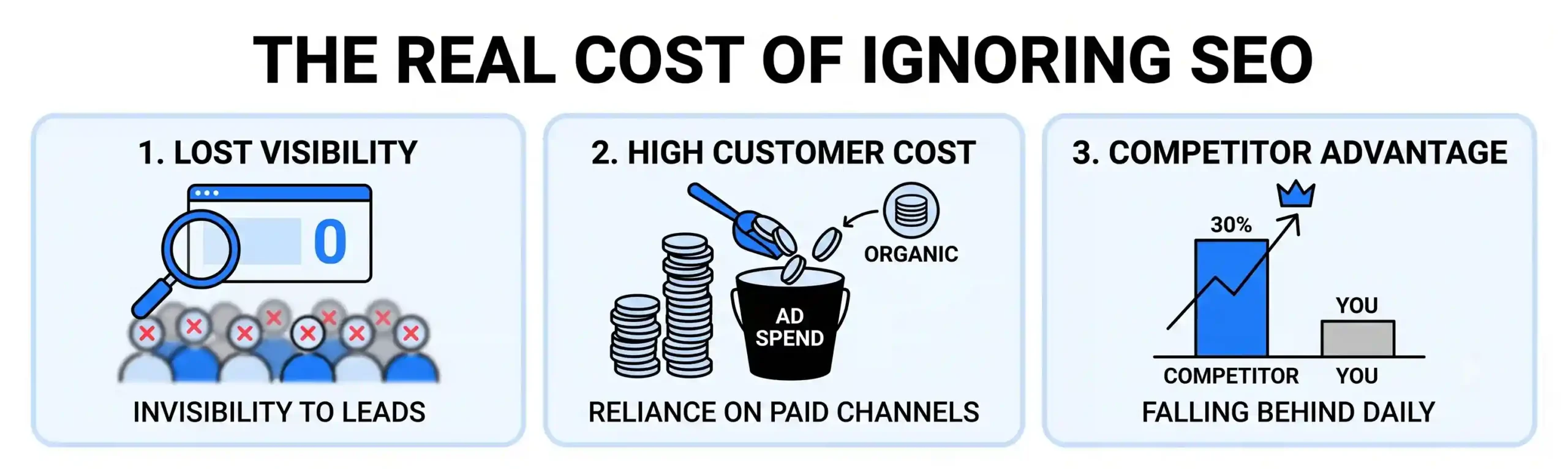
Roughly 68% of online experiences begin with a search engine, and the top five organic results capture the large majority of clicks – with position one alone pulling in a significantly higher share than page two results, which barely register at all. If your business isn’t on page one for the terms your customers are actually searching, you’re not “missing out a little.” You’re functionally invisible to most of that demand.
Case in Point: What This Looks Like in Practice
Take a local service business – say, a mid-sized plumbing company – searching “[emergency plumber + city name].” That’s a high-intent search: someone has a problem right now and is ready to hire. If that business isn’t ranking, every one of those searches goes to a competitor instead, and it happens dozens of times a month, silently.
Now scale that across every keyword relevant to a business: service terms, product categories, “near me” searches, comparison searches. Each one a business doesn’t rank for is a small, repeated leak. None of them show up on a P&L line labeled “SEO,” but together they add up to a real number in lost revenue.
Paid Ads Don’t Fix This – They Just Hide It Temporarily
A common response to weak organic visibility is to lean harder on paid search. That works, but it’s borrowed visibility – the moment the ad budget stops, so does the traffic. SEO builds visibility that stays even when spend doesn’t.
We’re not anti-paid-ads. Ads are the right call when you need traffic now, especially for a new business with zero organic footprint. But treating ads as a permanent substitute for SEO means paying rent forever on visibility you could eventually own.
Competitors Are Compounding While You Wait
SEO is one of the few marketing channels that compounds. A blog post or optimized page published today can keep ranking and generating leads a year from now with no additional spend. That’s the upside most businesses underweight.
The flip side is what ignoring it costs: while your business waits, competitors who are investing in SEO are building authority – backlinks, ranking history, content depth – that gets harder to catch up to the longer it goes uncontested. Delaying SEO by a year doesn’t just cost you that year’s traffic. It costs you a year of head start you’re handing directly to whoever is willing to show up in the results instead of you.
Where This Actually Hits the Bottom Line
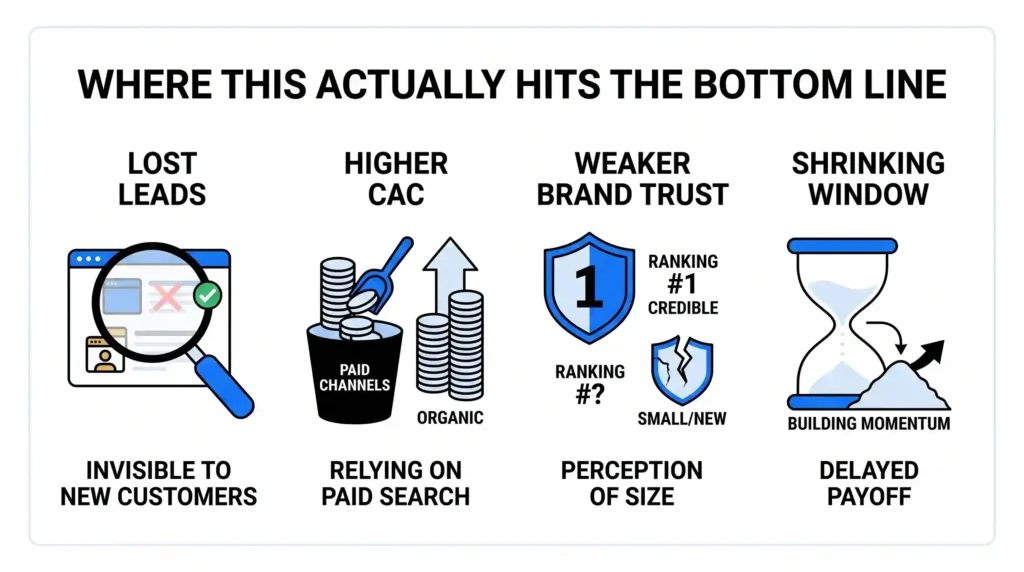
- Lost leads: potential customers who searched, found a competitor, and never knew your business existed
- Higher customer acquisition cost: relying entirely on paid channels to do what organic search could do for free, long-term
- Weaker brand trust: buyers associate high organic rankings with credibility, whether that’s fair or not – showing up on page one signals “established,” not showing up signals “new or small”
- A shrinking window to catch up: SEO gains take months to materialize, so every month of delay pushes the payoff further out
The Bottom Line
Ignoring SEO doesn’t mean nothing happens. It means something happens without you – customers search, find competitors, and buy from them instead, month after month, invisibly. The cost isn’t hypothetical; it’s just easy to miss because there’s no bill for it.
Want to see exactly what it’s costing your business right now? Get a free SEO audit and we’ll show you the gap in plain numbers, not jargon.
How Much Revenue Are You Losing to Competitors?
Stop letting search traffic slip away silently. Connect with the Nuclay team to claim your free SEO audit and uncover your hidden revenue gap.
Get Your Free SEO AuditFrequently Asked Questions (FAQ)
Is SEO worth it for a small, local business, or just bigger companies?
It's often more valuable for small local businesses, since local search intent ("near me," city-specific searches) tends to have less competition and higher buying intent than broad national terms.
What's the actual cost of doing nothing, in dollars?
It varies by industry and search volume, but a simple way to estimate it: take your average customer value, multiply by the monthly search volume for your core keywords, and apply a realistic click-through and conversion rate. The number is almost always higher than owners expect.
Can I just rely on social media instead of SEO?
Social media reaches people who already follow you; SEO reaches people actively searching for what you sell, often with no prior awareness of your brand. They serve different purposes and work best together, not as substitutes.
Do I need a huge budget to start fixing this?
No. Even foundational fixes - accurate business listings, on-page keyword targeting, basic technical cleanup - move the needle before any large content investment. The bigger cost is delay, not spend.