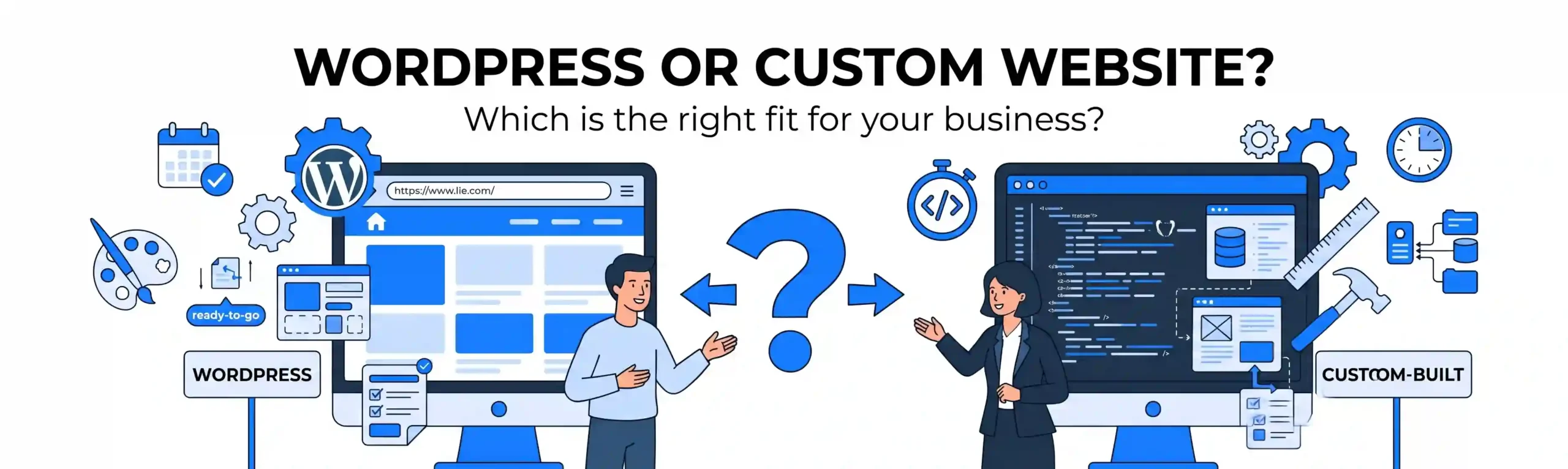
The WordPress vs custom website question usually arrives in the middle of a budget conversation. One developer quotes ₹60,000 for a WordPress site. Another quotes ₹4 lakh for a custom build. Both claim theirs is the right choice, and you’re left guessing who is selling what.
Here is the short version of our position: most small and mid-sized businesses should start on WordPress, and a smaller group genuinely needs a custom build. This post explains where the line sits, what each option really costs over time, and how to decide without being sold to.
What Is the Difference Between WordPress and a Custom Website?
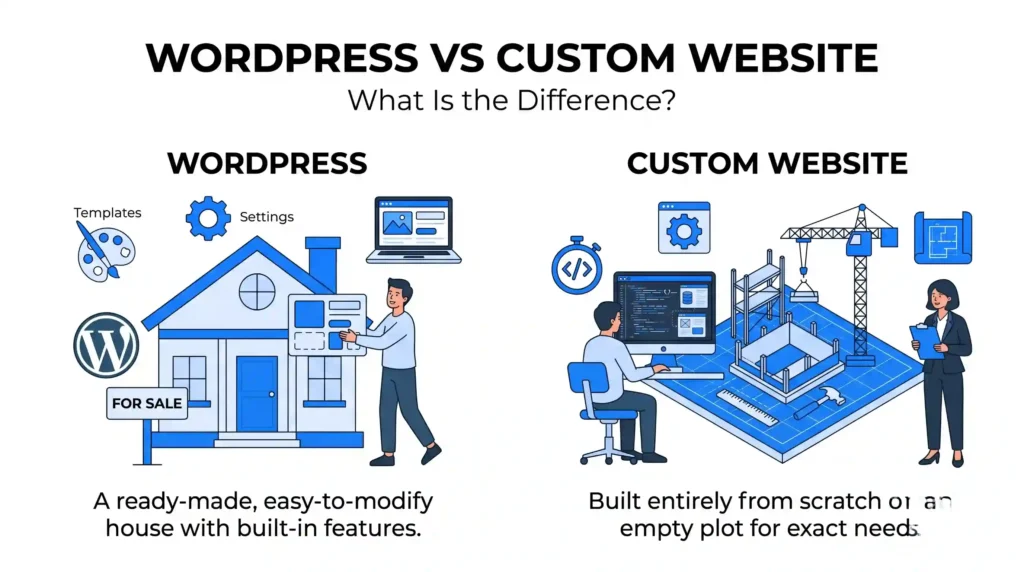
WordPress is a ready-made platform. It gives you a content management system (software that lets you edit pages without touching code), a library of themes for design, and thousands of plugins for features like forms, bookings and payments. A developer assembles and tailors these pieces for you.
A custom website is built from scratch for your exact needs. Developers write the code, design the structure and build every feature to your specification, using frameworks such as React, Laravel or Django instead of a prebuilt platform.
Think of WordPress as a well-designed ready-to-modify house, and a custom site as one designed and built on an empty plot. Both can be excellent. The question is whether your needs justify an empty plot.
How Do WordPress and Custom Websites Compare on Cost?
Cost is where most decisions get made, so here is a realistic picture for Indian businesses:
| Factor | WordPress | Custom Website |
| Typical build cost | ₹30,000 to ₹1.5 lakh | ₹2 lakh to ₹10 lakh or more |
| Time to launch | 2 to 6 weeks | 2 to 6 months |
| Ongoing costs | Hosting, plugin licences, updates | Hosting, developer time for every change |
| Changing something later | Often quick and cheap | Usually needs a developer |
The pattern to notice is that WordPress is cheaper upfront, while custom sites tend to cost more to change. A custom site is not automatically more expensive forever, but you are paying for flexibility you may never use.
When Is WordPress the Better Choice?
WordPress is the right call when your website’s job is to present your business, publish content and generate enquiries. That covers most service businesses, clinics, schools, consultants, local shops, restaurants and content-driven brands.
Choose WordPress when:
- You want to launch quickly. A well-built business site can go live within a few weeks.
- Your team will edit content. Staff can update pages, add blog posts and change images without calling a developer.
- SEO matters. WordPress handles page structure, URLs and metadata well, and good SEO tools already exist for it.
- Your budget is limited. You get a professional result without paying for features you won’t use.
For example, a coaching institute with course pages, a fee structure, testimonials and an enquiry form has no reason to commission a custom build. WordPress covers everything it needs at a fraction of the price.
When Does a Custom Website Make Sense?
A custom website earns its cost when your business logic is unusual enough that a standard platform would fight you at every step.
Custom is the right choice when:
- You’re building a web application, not just a website. Think customer dashboards, booking engines with complex rules, marketplaces, or software sold as a service.
- You need heavy integrations. Connecting to your CRM, ERP, payment systems and inventory in custom ways often works better when built directly.
- Performance at scale is critical. If you expect very high traffic or complex data handling, a purpose-built system gives you control.
- Your requirements are unique. If you’ve described your needs and a developer says “WordPress would need five plugins stitched together for that,” listen.
The test we use: if you can describe your site mostly as pages, a blog and forms, it’s a WordPress job. If you describe it using words like “logged-in users,” “workflows” and “real-time,” it’s likely a custom job.
What About Security and Maintenance?
This is the most misunderstood part of the debate. WordPress powers a very large share of websites, so attackers target it heavily. That does not make it insecure, but it does mean neglected sites get hacked. Outdated plugins are the usual cause.
A WordPress site is safe when you do four things: keep core software and plugins updated, install only well-reviewed plugins, use strong login protection, and keep regular backups.
Custom websites have a smaller public attack surface because nobody is scanning for known flaws in a generic platform. But they depend entirely on how well the developer wrote the code. A badly built custom site can be less secure than a well-maintained WordPress one.
Either way, plan for ongoing maintenance. A site you launch and never touch will eventually cause a problem.
Can You Start With WordPress and Move to Custom Later?
Yes, and for many businesses this is the smartest path. Launch on WordPress, learn what your customers actually use, and invest in custom development only when a clear limit appears.
The trick is to plan for it. Keep your content organised, own your domain and hosting, and avoid cluttering the site with dozens of plugins. If you later build custom, you can migrate the content and keep your search rankings with proper redirects.
The costly mistake is going custom first on a hunch. We’ve seen businesses spend several lakhs on a bespoke site, only to discover that what they needed was a faster way to publish pages.
A Quick Decision Guide
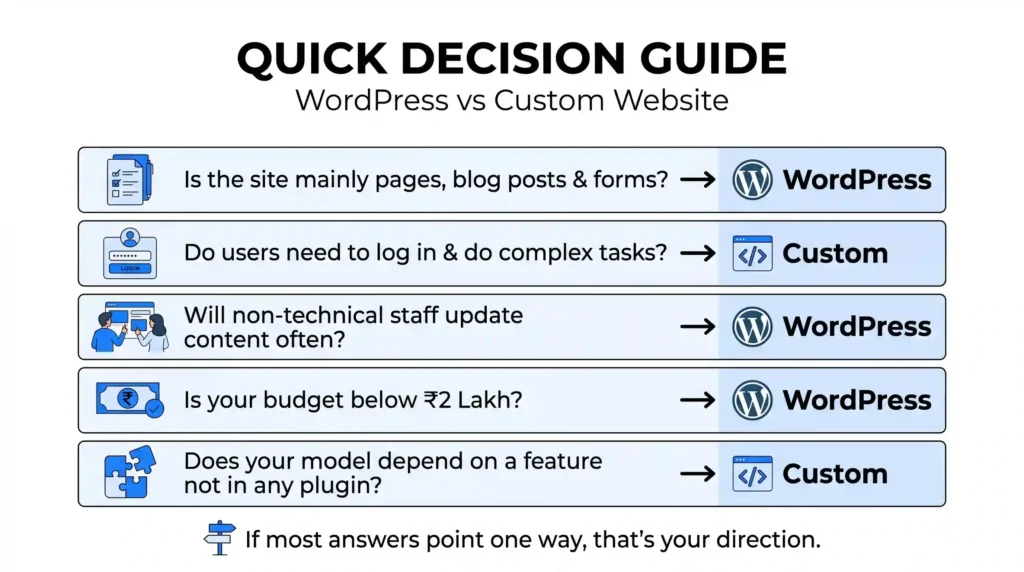
Answer these five questions:
- Is the site mainly pages, blog posts and forms? WordPress.
- Do users need to log in and do complex tasks? Custom.
- Will non-technical staff update content often? WordPress.
- Is your budget below ₹2 lakh? WordPress.
- Does your business model depend on a feature that doesn’t exist in any plugin? Custom.
If most of your answers point one way, that’s your direction.
Conclusion
WordPress is the sensible default for businesses that need a fast, affordable, easy-to-manage website. A custom build is the right investment when your product or workflow is unusual enough to demand it. Start from what your website needs to do, not from what sounds more impressive, and the choice usually becomes obvious.
Not sure where your project falls? Get a custom quote from the Nuclay team, and we’ll tell you honestly whether WordPress or a custom build serves you better.
WordPress or Custom Build: Not Sure Which You Need?
Connect with the Nuclay team for an honest recommendation and a custom quote that fits your exact business stage.
Get An Honest QuoteFrequently Asked Questions (FAQ)
How much does a custom website cost compared to WordPress in India?
A WordPress business website typically costs between ₹30,000 and ₹1.5 lakh, while a custom website usually starts around ₹2 lakh and can exceed ₹10 lakh for complex projects. The final price depends on features, design and integrations.
Is WordPress secure enough for a business website?
Yes, when it is maintained properly. Keeping WordPress core and plugins updated, using trusted plugins, enabling strong login protection and taking regular backups makes it secure for most business needs.
Is a custom website better for SEO than WordPress?
Not automatically. WordPress has strong built-in SEO capabilities and many tools, while a custom site can match or exceed it only if the developer builds in clean URLs, fast loading and proper metadata. Content quality matters more than the platform.
Can I switch from WordPress to a custom website later?
Yes. You can move your content and keep your search rankings by setting up proper redirects from old pages to new ones. Planning the move in advance makes the switch smoother and less costly.