Launching a website means buying three things before a single visitor can see it: a domain, hosting, and an SSL certificate. Sellers bundle them, rename them, and upsell them, so it’s easy to overpay or buy something you don’t need.
This guide explains domain, hosting and SSL in plain language. You’ll learn what each one does, what a fair price looks like, and the exact shopping list for most small business websites. No technical background needed.
What Is a Domain Name?
A domain name is your website’s address, like nuclay.com. People type it into a browser to reach you, and it’s the one part of your online identity that you fully own.
You don’t buy a domain forever. You rent it, usually one year at a time, from a registrar (a company authorised to sell domains). In India, a .com typically costs ₹700 to ₹1,200 a year, and a .in is often cheaper.
Our view: buy the .com if you can, and add the .in if you serve Indian customers. Keep the name short, easy to spell out over a phone call, and free of hyphens and numbers.
What Is Web Hosting?
Hosting is the computer (called a server) that stores your website’s files and sends them to visitors whenever they open your address. If the domain is your street address, hosting is the plot of land and the building on it.
You have three common choices:
- Shared hosting: Your site shares a server with many others. It’s the cheapest option, often ₹100 to ₹500 a month, and fine for a small business site with modest traffic.
- VPS or cloud hosting: You get a dedicated slice of a server. It costs more, often ₹1,000 to ₹5,000 a month, and suits growing sites, online stores, and custom web applications.
- Managed hosting: The provider handles updates, security and backups for you. It’s pricier but saves time if nobody on your team is technical.
For example, a local dental clinic with a five-page site and a booking form is perfectly served by good shared hosting. An online store with hundreds of products and daily orders should start on cloud or managed hosting.
What Is an SSL Certificate and Do You Really Need One?
An SSL certificate encrypts the connection between your visitor’s browser and your website, so details like names, phone numbers and card numbers can’t be read in transit. When it’s active, your address begins with https:// and browsers show a padlock.
Yes, you need one, with no exceptions. Browsers label sites without SSL as “Not secure,” which scares visitors away, and Google treats HTTPS as a ranking signal. Contact forms and checkout pages are unsafe without it.
The good news is that SSL is often free. Most hosting providers include a free certificate (usually from Let’s Encrypt) that renews automatically. Paid certificates exist, but a small business site rarely needs one.
How Do Domain, Hosting and SSL Work Together?
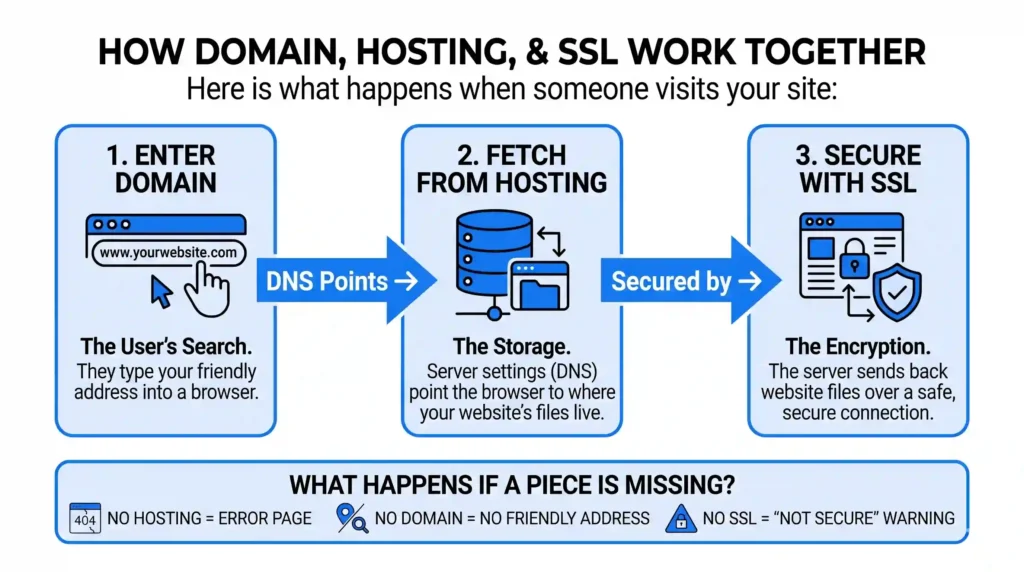
Here is what happens when someone visits your site:
- They type your domain name into a browser.
- The domain’s settings (called DNS records) point the browser to the server where your hosting lives.
- The server sends back your website’s files over a secure connection protected by SSL.
All three must be set up and connected, and a missing piece breaks the chain. A domain with no hosting shows an error page. Hosting with no domain has no friendly address. A site with no SSL shows a warning.
What Should You Buy to Launch a Website? A Simple Shopping List
For a typical small business website, this is all you need:
- A domain name: ₹700 to ₹1,200 a year
- Hosting: ₹1,500 to ₹6,000 a year for decent shared hosting, or more for cloud
- SSL certificate: free with most hosts
- Business email (optional but smart): addresses like name@yourcompany.com look more trustworthy than a Gmail account, and usually cost a few hundred rupees a month per user
All in, many small business sites can launch for under ₹10,000 a year in infrastructure costs, before design and development.
Should You Buy Everything From One Company?
Not necessarily, and we’d advise against it for one reason: ownership. Register your domain in your own name and your own account, even if a developer or agency handles everything else. We’ve seen businesses locked out of their own address because a freelancer registered it under their name and then went silent.
Buying hosting and the domain separately also makes it easier to move your site later without losing your address. Using one provider for both is convenient, but make sure you hold the login.
Common Mistakes When Buying Domain, Hosting and SSL
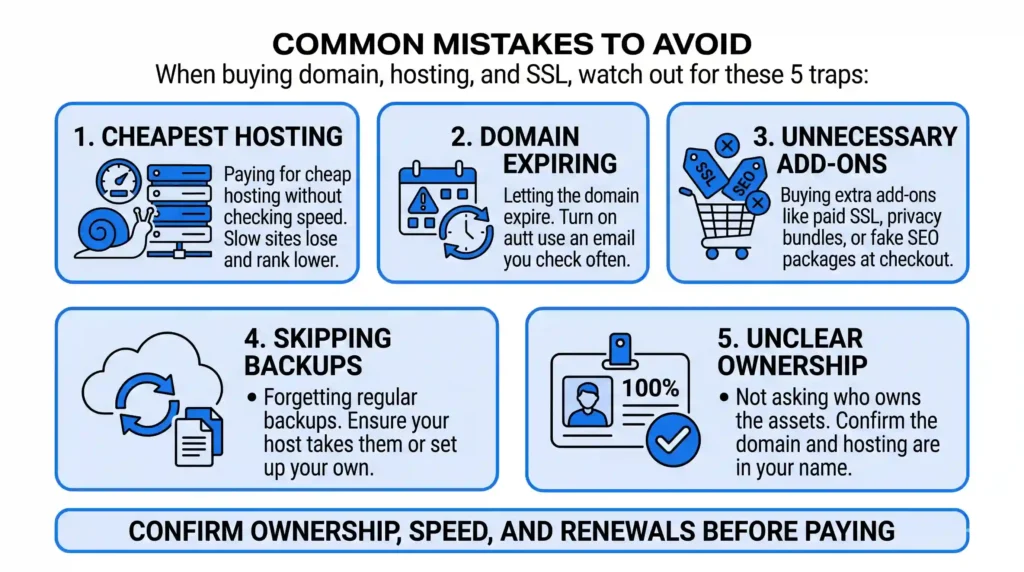
- Paying for the cheapest hosting without checking speed. Slow sites lose visitors and rank lower.
- Letting the domain expire. Turn on auto-renewal and use an email address you check often. Expired domains can be snapped up by others.
- Buying add-ons you don’t need. Many sellers push paid SSL, domain privacy bundles and “SEO packages” at checkout. Skip anything you don’t understand.
- Forgetting backups. Make sure your host takes regular backups, or set up your own.
- Not asking who owns what. Always confirm that the domain and hosting accounts are in your name.
Conclusion
To launch a website, you need a domain for the address, hosting for the space, and SSL for security. For most small businesses that means a short, memorable domain, reliable shared or cloud hosting, and a free SSL certificate, all registered in your own name. Get these three right and the rest of the project becomes far easier.
Unsure which hosting plan or domain setup fits your business? Talk to our web team, and we’ll help you choose the right setup and launch it properly.
Unsure How to Set Up Your Site?
Get the right domain, hosting, and SSL from day one. Talk to the Nuclay team to launch hassle-free.
Talk to Our Web TeamFrequently Asked Questions (FAQ)
Do I need to buy SSL separately from my hosting?
Usually not. Most hosting providers include a free SSL certificate that activates automatically. You would only buy a separate paid certificate for special cases, such as extended business validation requirements.
How much does it cost to launch a website in India?
Infrastructure for a small business site, covering a domain, shared hosting and SSL, typically costs under ₹10,000 a year. Design and development are separate costs and vary widely depending on the size and features of the site.
Can I buy a domain name without hosting?
Yes. A domain can be registered on its own and held until you are ready to build a website. It won't show a working site until you connect it to hosting.
Who should own my domain name: me or my web developer?
You should. The domain should be registered in your name with your own login, even when a developer manages the technical work. This prevents you from being locked out if the working relationship ends.