Every January, a fresh wave of “trends” arrives. Small business owners are told to be on ten new platforms, run five new tools, and rebuild their strategy from scratch. You don’t have the team or the budget for that, and you shouldn’t try.
This post covers the digital marketing trends of 2026 that matter for a small business, and which ones are worth your limited time. Three deserve action this quarter, a few can run quietly in the background, and the rest can wait.
Here’s our stance up front: most 2026 trends are variations on one idea. People get answers faster than ever and expect businesses to respond just as fast. If your marketing helps with both, you’re ahead of most competitors.
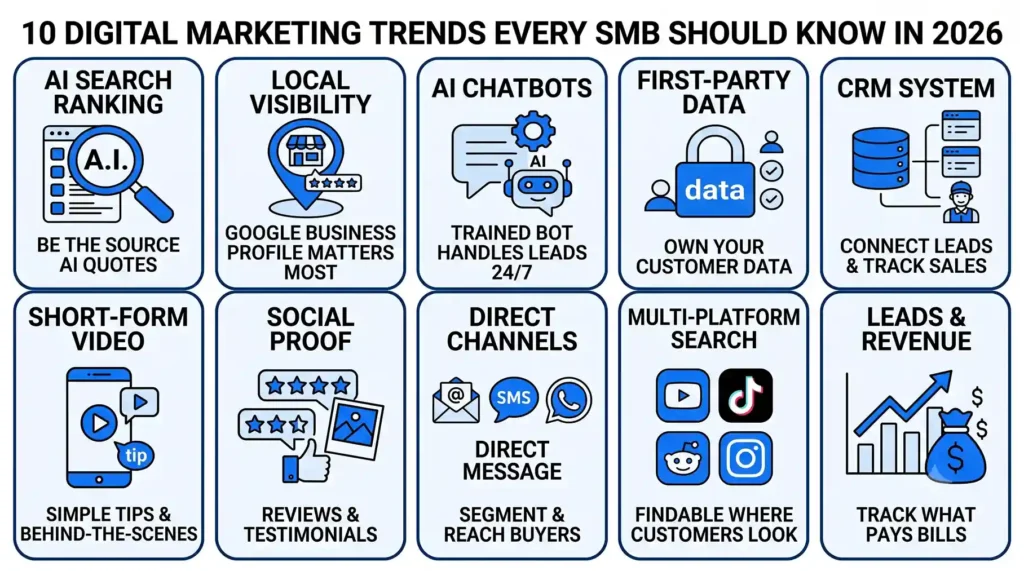
1. AI Search Is Now Part of Your Google Ranking Problem
More searches now end on an AI-generated answer before anyone clicks a link. Google’s AI Overviews, ChatGPT, Perplexity and similar tools pull from web pages and summarize them.
For a small business, ranking #3 isn’t enough anymore. You also want to be the source the AI quotes. That mostly comes down to clarity:
- Answer real customer questions directly, near the top of the page
- Keep your business name, address, services and pricing consistent everywhere online
- Use plain headings that match how people actually ask questions
Google’s own guidance says there’s no special trick for showing up in AI features. Good, helpful content is still the foundation. Action level: high. Treat this as your SEO strategy, not a separate project.
2. Local Visibility Beats Broad Traffic
If you serve a specific area, your Google Business Profile often matters more than your homepage. It’s what appears on the map, in “near me” searches, and increasingly in AI answers about local services.
Keep it alive with fresh photos, accurate hours, detailed service listings, and a steady flow of new reviews. A realistic target for most local businesses is five to ten new reviews a month. That tells Google, and customers, that you’re active and trusted.
Action level: high. It’s cheap, and it’s where local buyers make decisions.
3. AI Chatbots That Actually Handle Leads
Basic website chat widgets that say “we’ll get back to you” are dead weight. The 2026 version is a chatbot trained on your own content (services, price ranges, FAQs, policies) that answers questions and books appointments at 11 p.m.
Picture a dental clinic with 40 website visitors a day, most browsing after work. If those visitors can only fill in a form and wait until tomorrow, many will book with whichever clinic answers first. A trained chatbot closes that gap by answering “Do you take my insurance?” and “Can I get a Saturday slot?” on the spot.
The key word is trained. A generic bot that guesses will hurt your brand. One built on your actual information feels like a helpful front desk.
Action level: high, especially if you get inquiries outside business hours.
4. First-Party Data and a Real CRM
Third-party tracking keeps getting harder, and privacy rules keep tightening. The businesses that stay effective are the ones that own their customer data: emails, purchase history, inquiry sources, and follow-up notes. This is called first-party data, meaning information customers give you directly.
If your leads live in a mix of inboxes, spreadsheets and WhatsApp threads, you can’t measure what’s working or follow up consistently. A CRM (customer relationship management system) such as Salesforce or a lighter alternative, connected to your website and forms, fixes that.
Action level: high. Every other trend on this list works better with clean customer data behind it.
5. Short-Form Video, Without the Production Budget
Short vertical video (Reels, Shorts, TikTok) is still one of the most efficient ways to get in front of new people. It doesn’t need studio gear. A phone, decent lighting and one useful tip per clip is enough.
What works for small businesses:
- A 30-second answer to a question customers ask you every week
- Behind-the-scenes footage of a job, a product being made, or a before-and-after
- The owner or a team member on camera, since people trust faces
Posting several simple clips a month beats one expensive brand film. Action level: medium. Pick one platform where your customers actually spend time.
6. Social Proof Is the New Advertising
Buyers trust other buyers. Reviews, customer photos, testimonials and micro-influencer partnerships (creators with a few thousand engaged local followers) increasingly do the work ads used to do.
Build the habit of asking for a review right after a good experience, then reuse it everywhere: your site, your ads, your profiles. Action level: medium. Low cost, high return.
7. Direct Channels: Email, SMS and WhatsApp
Social reach shifts with every algorithm change. A message to a customer who opted in doesn’t. Email, SMS and WhatsApp let you reach people directly, and for repeat buyers they usually cost far less per sale than paid ads.
Start simple: a welcome message, an appointment reminder, a “we haven’t seen you in a while” nudge. Segment by behavior instead of blasting everyone. Action level: medium.
8. People Search Everywhere, Not Just on Google
Customers now search on YouTube, TikTok, Reddit, Instagram and inside AI tools. That doesn’t mean you need to be everywhere. It means your expertise should be findable wherever your specific customers look.
Ask your last five customers where they searched before contacting you. The answers will tell you more than any trend report. Action level: medium.
9. AI-Assisted Content, With a Human in the Loop
Yes, AI can draft your blog posts, emails and social captions in minutes. Yes, everyone else is doing this too, which is exactly the problem. Unedited AI content sounds the same across every business, and readers and search engines notice.
Use AI for outlines, first drafts, repurposing and research. Then add what only you have: real examples, real prices, real opinions, real customer stories. Action level: medium. Use the speed, keep the personality.
10. Measure Leads and Revenue, Not Vanity Numbers
Likes and impressions feel good, but they don’t pay bills. The businesses pulling ahead in 2026 track a handful of numbers:
- Leads per month
- Cost per lead
- Lead-to-customer rate
- Revenue by source
If you can’t say which channel brought your last five customers, fix that before adding anything new. Action level: high, and it’s the foundation for every decision above.
Which Trends Should You Actually Act On?
If you only have bandwidth for three things, start here:
- Tighten your local and AI search presence (trends 1 and 2)
- Respond faster with a trained chatbot (trend 3)
- Get your customer data into one CRM (trends 4 and 10)
Everything else becomes more effective once those three are in place. Skip anything that needs a new platform, a big budget, and no clear way to measure results.
To Sum it Up
The trends that matter in 2026 aren’t exotic. Be findable when people search (including in AI tools), reply quickly, own your customer data, and measure what turns into revenue. The rest is optional.
If you’re not sure where your business stands on any of these, that’s what a conversation is for. Book your free consult with Nuclay and we’ll look at your current marketing, point out the two or three moves that would make the biggest difference, and tell you honestly what to ignore.
Frequently Asked Questions (FAQ)
How much should a small business spend on digital marketing in 2026?
A commonly cited guideline, including from the U.S. Small Business Administration, is 7-8% of gross revenue for businesses under $5 million a year. Newer businesses chasing fast growth often go higher. Start with channels where you can measure leads, then put more money into what works.
Is SEO still worth it with AI search taking over?
Yes. AI tools pull answers from web pages, so well-structured, trustworthy content is what gets cited. SEO hasn't disappeared. It now includes being the clearest source of an answer.
Do I need to be on every social platform?
No. Choose one or two platforms where your customers already spend time and do them consistently. Spreading yourself across six platforms usually means doing all six badly.