AI Chatbots – Your One Stop Digital Solution

AI Chatbots

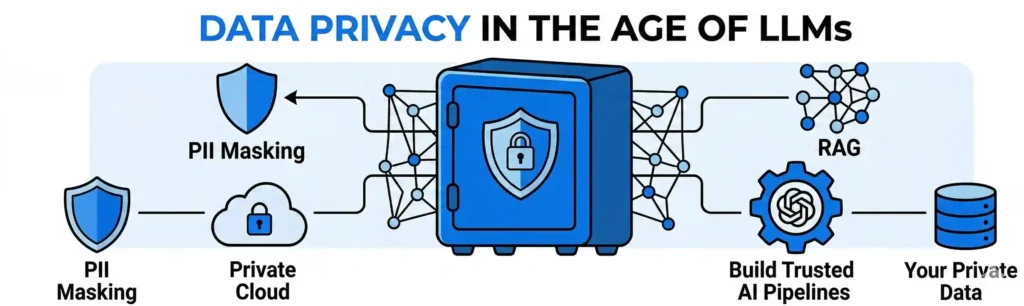
A sleek horizontal banner titled "DATA PRIVACY IN THE AGE OF LLMs" centered around a secure blue vault icon connected to graphics for PII Masking, Private Cloud, RAG, and Trusted AI Pipelines.
Content, Databases, LLM & AI Chatbot, Technology, Trends

Data Privacy in the Age of LLMs

Is your AI a leak or a vault? In 2024, the priority was AI capability. In 2026, the priority is AI integrity. As businesses move from basic chatbots to integrated AI Agents that handle sensitive CRM and financial data, a new risk has emerged: the AI Privacy Gap. You cannot leverage the full power of a Large Language Model (LLM) if you are constantly worried about where your data goes. At Nuclay, we treat privacy as the foundation that makes AI scalable, not a hurdle that slows it down. Understanding the AI Privacy Risks Traditional data privacy focuses on who can access a file. LLM privacy is more complex because it involves how a model “learns” and “processes” information. The three primary risks for businesses today: Technical Solutions for Data Security To use AI safely, businesses must move away from public web-chat interfaces and toward Private AI Infrastructure. We implement three core technologies to ensure your data stays yours: 1. Retrieval-Augmented Generation (RAG) Instead of “teaching” a model your secrets via fine-tuning (which makes the data part of the model’s permanent memory), we use RAG. The AI is given temporary access to a “private library” of your documents. It reads the relevant file, answers the specific query, and then the context is cleared. Your data remains in your secure vault; only the answer is generated. 2. PII Masking Gateways We build automated “Gatekeepers” between your team and the AI. Before a prompt reaches the LLM, a scanning layer identifies and redacts Personally Identifiable Information (PII)such as social security numbers, private keys, or client names. This ensures that even if a model provider experiences a breach, your sensitive data was never sent to them in the first place. 3. Private Cloud Deployment For maximum security, we deploy models within your own private cloud environment (AWS, Azure, or GCP). This creates a “Closed Loop” where the data, the model, and the processing power all live within your company’s existing security perimeter. Not even the AI provider can see the interactions. Privacy as a Competitive Advantage Most organizations are moving slowly because they are paralyzed by security concerns. By building Privacy by Design, you remove that friction. When your backend architecture is verified as secure, you can deploy AI agents across every department from HR to Finance without risk. In 2026, the most successful companies aren’t just the ones with the smartest AI; they are the ones with the most trusted data pipelines. Secure Your AI Strategy Your proprietary data is your most valuable asset. In the race to automate, you shouldn’t have to choose between innovation and security. At Nuclay Solutions, we specialize in building the bridges and vaults that allow your business to use the world’s most powerful LLMs with total peace of mind. We turn privacy into a strategic asset that allows you to move faster than the competition. Secure Your Proprietary Data. Stop data leaks. Build your private AI vault today. Discuss AI Strategy

LLM & AI Chatbot, Technology, Trends

The Clean Code Mandate: Solving Tech Debt

“We’ll fix it later.” In software development, “later” is the most expensive word in the dictionary. When you rush a feature to market by taking shortcuts, you aren’t just saving time, you are taking out a high-interest loan. In the tech world, we call this Tech Debt. By 2026, many businesses are finding that their “loan” has come due. If your development team is moving slower than they were a year ago, or if simple updates now cause massive system crashes, you are likely drowning in unmanaged debt. You aren’t lacking talent; you are lacking a clean foundation. Why Tech Debt Happens Tech Debt isn’t always caused by bad engineers; it’s usually caused by speed. When a business prioritizes a deadline over structural integrity, developers write “quick and dirty” code to bridge the gap. While this might help you launch on time, it creates a “fragility” that compounds every time you add a new layer. The result is “Spaghetti Code”: The Clean Code Standard Clean Code is the practice of writing software that is self-explanatory, organized, and modular. Think of your software like a warehouse: Tech Debt is throwing boxes on the floor just to get them inside faster. Clean Code is putting them on labeled, accessible shelves. How we solve it: Moving From Maintenance to Innovation The true cost of Tech Debt isn’t just the bugs it’s the opportunity cost. Most legacy businesses spend 80% of their IT budget just “keeping the lights on” and fixing old errors. That leaves only 20% for the innovative features that actually grow the business. By enforcing the Clean Code Mandate, we flip that ratio. Across 80+ projects, we’ve seen that cleaning the “core” of a system allows teams to move 3x faster. You stop being a “Digital Janitor” cleaning up past messes and start being an “Architect” building the future. When your foundation is clean, your developers spend their time building new tools for your customers rather than chasing ghosts in the machine. Building Tech Equity Your software should be a strategic asset that gains value over time, not a liability that drains your bank account. If your current system feels like an anchor holding you back from the AI revolution, it’s time to settle the debt. At Nuclay Solutions, we specialize in identifying the specific “bottlenecks” in your architecture, the 20% of your code causing 80% of your headaches and refactoring them into a clean, AI-ready engine. We help you transition from fragile legacy systems to a scalable, modern stack. Is your code holding you back? Don’t let old tech slow you down. We turn messy legacy systems into modern, AI-ready engines. Modernize My Stack Build the future with Nuclay.

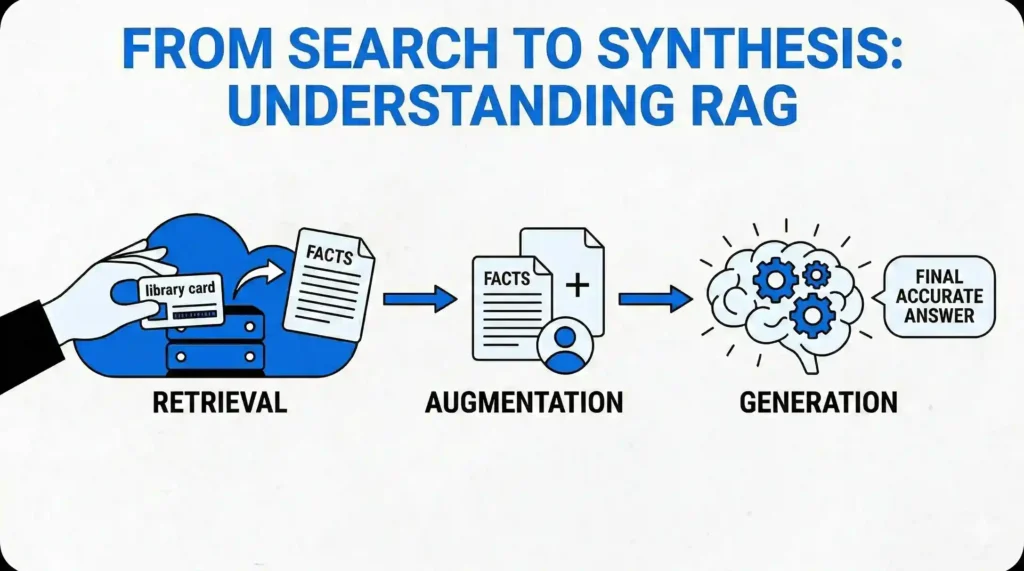
Stop AI hallucinations. Learn how Retrieval-Augmented Generation (RAG) connects a generative "Brain" to your private "Source of Truth" for 100% accurate, safe, and real-time AI insights.
LLM & AI Chatbot, Trends

Understanding RAG from Scratch

Have you ever asked a standard AI a specific question about your company, only for it to give you a confident but completely wrong answer? In the tech world, we call that a “hallucination.” It happens because most AI models are trained on the public internet, not on your private business data. To solve this, we use a breakthrough architecture called RAG (Retrieval-Augmented Generation). It is the difference between an AI that “guesses” and an AI that “knows.” How RAG Works Imagine you hire a brilliant assistant who has read every book in the world but has never stepped foot inside your office. If you ask them, “Who was our top donor last year?” they will try to guess based on general information. That is a standard AI. RAG changes the game by giving that assistant a library card to your private archives. When you ask a question using RAG: Why RAG is the Gold Standard for 2026 In 2024, businesses were afraid to use AI because they couldn’t trust the output. In 2026, RAG has eliminated that fear. By connecting a generative “Brain” to a verified “Source of Truth,” we ensure your AI remains both smart and safe. Here is why RAG is a non-negotiable for your business: Is Your Data “AI-Ready”? RAG is powerful, but it requires a clean “library” to work. If your data is scattered across old spreadsheets and messy folders, the AI will struggle to find the right books. Check your readiness: If you have the data, we have the “Library Card” technology to make it talk. The Nuclay Approach At Nuclay, we specialize in building these private “libraries” for our clients. We’ve delivered over 80 projects where we turn stagnant company data into active, synthesizable knowledge. We don’t just give you a chatbot; we give you a system that understands your business as well as you do. The era of “searching” for files is over. The era of “asking” your data is here.Stop Searching. Start Knowing. Is your company data working for you, or is it just sitting in a digital filing cabinet? Most businesses are sitting on a goldmine of information they can’t easily access. At Nuclay Solutions, we specialize in building the architecture that brings that data to life. Let’s discuss your current tech stack and explore how a custom RAG implementation can turn your internal documents into a massive strategic advantage. Stop Searching. Start Knowing. Don’t let your data sit in a digital filing cabinet.Build a private AI library that understands your business. Schedule Consultation Build the future with Nuclay Solutions. @media (max-width: 480px) { .nuclay-rag-cta { padding: 35px 15px !important; width: 95% !important; } }

A team of business professionals manually managing customer data, charts, and profiles on a large CRM interface.
CRM, LLM & AI Chatbot

The AI Revolution Starts with Your CRM

Wait! Before you read any further, look at how many tabs you have open in your browser right now. If you are like most business leaders in 2026, it is probably more than ten. You have one tab for your email, one for your CRM, one for your team chat, and three more for various tracking spreadsheets. For the last decade, we were told that “Digital Transformation” meant buying more software. But instead of making our lives easier, we often just became “Data Entry Clerks” for the tools we pay for. This digital clutter is the exact reason why we believe the era of “using” software is over. The era of “leading” software has begun. The 2026 Reality Check: Is Your CRM a Library or a Brain? To move from being a user to a leader, you have to look at your core systems differently. Most companies treat their CRM (like Salesforce) as a digital filing cabinet. You put information in, and it sits there until a human goes looking for it. In the AI Revolution, your CRM needs to stop being a passive library and start being an active brain. The 10-Second Audit Ask yourself these three questions: If you answered “No” to any of these, you don’t actually have an AI problem—you have a CRM integration problem. And once that integration is fixed, your daily role shifts from clicking buttons to orchestrating intelligence. How AI Agents are Replacing Manual CRM Tasks in 2026 The biggest mistake companies make in 2026 is thinking that AI is just a chatbot sitting on their website. In reality, true AI power starts deep inside your data. When your AI is correctly plugged into your CRM, you stop performing repetitive tasks and start managing “Agents” that do them for you. Imagine how your morning changes with this automated workflow: Why Integration Beats Experimentation While the workflow above sounds like magic, it is actually the result of disciplined engineering. You might have played with AI prompts before, but prompts are just words. Pipelines are results.At Nuclay, we have completed over 80 projects helping organizations move away from “messy tech” and toward these “intelligent flows.” Through that experience, we found that the companies winning in 2026 aren’t necessarily the ones with the smartest humans; they are the ones with the best-connected data.The lesson is simple: Don’t ask what AI can say. Ask what AI can do when it has access to your CRM. Your First Step Toward the Revolution Achieving this level of automation doesn’t require you to delete your current systems and start over. It simply requires you to build a bridge between the data you already have and the new world of AI Agents. We want to help you build that bridge. Think about the one manual task in your CRM that you hate doing every single day: We at Nuclay Solutions are building the tools to make that “hate-to-do” list disappear forever. Are you ready to stop using software and start hiring it? Let’s build the future together. Stop Using Software. Start Hiring It. Turn your CRM from a passive filing cabinet into an active intelligence brain with custom AI Agents. Schedule Your CRM Audit Build the future with Nuclay Solutions. /* This ensures that on very small screens, the padding doesn’t squeeze the content too much */ @media (max-width: 480px) { .nuclay-responsive-cta { padding: 30px 15px !important; width: 95% !important; } }

LLM & AI Chatbot

Generative AI vs. Predictive AI: Unraveling the Differences in the AI Landscape

Artificial Intelligence (AI) has become a cornerstone of technological innovation, driving advancements across industries and transforming the way we interact with technology. Among the various branches of AI, two have gained significant attention for their unique capabilities: Generative AI and Predictive AI. While both are integral to modern AI applications, they serve distinct purposes and operate on different principles. In this comprehensive guide, we will explore the differences between Generative AI and Predictive AI, delving into their methodologies, applications, and the value they bring to businesses and individuals. The Foundations of AI: An Overview Before diving into the specifics of Generative and Predictive AI, it is essential to understand the broader context of artificial intelligence. AI encompasses a wide range of technologies designed to mimic human intelligence. These technologies can perform tasks such as learning, reasoning, problem-solving, and understanding natural language. The core of AI lies in machine learning, where algorithms are trained on large datasets to recognize patterns and make decisions.  Generative AI: Creating from Scratch Generative AI refers to algorithms that can create new content or data similar to the input data they were trained on. This branch of AI uses models known as Generative Models, which can generate text, images, music, and even entire videos. The most well-known types of generative models include Generative Adversarial Networks (GANs), Variational Autoencoders (VAEs), and Transformer-based models like GPT-3. How Generative AI Works Generative AI models learn the underlying patterns of the input data and use this knowledge to generate new, similar data. For instance, GANs consist of two neural networks: a generator and a discriminator. The generator creates new data samples, while the discriminator evaluates their authenticity compared to real data. Through this adversarial process, the generator improves over time, producing increasingly realistic outputs. Applications of Generative AI Generative AI has a wide range of applications, including: – Content Creation: AI-generated content, such as articles, blog posts, and social media content, can help businesses maintain an active online presence. – Art and Design: Artists and designers use generative AI to create unique artworks, designs, and even animations. – Music Composition: Generative AI can compose music, offering new tools for musicians and producers. – Game Development: Game developers use generative AI to create realistic characters, landscapes, and scenarios. – Data Augmentation: In machine learning, generative AI can create synthetic data to augment training datasets, improving model performance. Predictive AI: Forecasting the Future Predictive AI, on the other hand, focuses on analyzing historical data to predict future outcomes. This branch of AI uses machine learning algorithms to identify patterns and trends in data, enabling it to make predictions about future events. Common types of predictive models include linear regression, decision trees, and neural networks.  How Predictive AI Works Predictive AI models are trained on historical data, learning to identify correlations and patterns. Once trained, these models can make predictions about new data inputs. For example, a predictive model trained on sales data can forecast future sales based on current market trends and consumer behavior.  Applications of Predictive AI Predictive AI is widely used across various industries, including: – Finance:  Predictive models help forecast stock prices, assess credit risk, and detect fraudulent transactions. – Healthcare: Predictive AI can predict disease outbreaks, patient outcomes, and treatment effectiveness. – Marketing: Businesses use predictive analytics to forecast customer behavior, optimize marketing campaigns, and personalize offers. – Supply Chain Management: Predictive AI helps companies forecast demand, manage inventory, and optimize logistics. – Retail: Retailers use predictive models to forecast sales, manage inventory, and analyze consumer trends.  Key Differences Between Generative AI and Predictive AI Objective: The primary objective of Generative AI is to create new data that closely resembles its training data, focusing on creative outputs such as generating text, images, or music. It is driven by the goal of producing content that mimics the characteristics of the input data. In contrast, Predictive AI aims to forecast future outcomes based on historical data. This involves identifying patterns and correlations within the data to make accurate predictions about future events, such as market trends, customer behavior, or disease outbreaks. Methodology: Generative AI employs models like GANs and VAEs, which involve a process of creating new data samples and refining them through iterative adversarial techniques. This methodology allows the generation of realistic and high-quality outputs. Predictive AI, on the other hand, utilizes models such as regression, decision trees, and neural networks. These models focus on analyzing past data to identify trends and predict future occurrences, providing valuable insights for decision-making processes. Applications: Generative AI finds its applications predominantly in creative fields, such as content creation, art, music composition, and game development, where the generation of new, unique outputs is essential. In contrast, Predictive AI is commonly applied in industries that rely heavily on forecasting and analysis, including finance, healthcare, marketing, and supply chain management. The ability to predict future outcomes allows businesses in these sectors to optimize strategies and operations. Data Utilization: Generative AI generates entirely new data, often requiring large datasets to train the models effectively and produce high-quality outputs. This capability is particularly valuable in areas where creating original and diverse content is crucial. Predictive AI, however, focuses on analyzing existing data to identify patterns and predict future events. It relies heavily on historical data for training and validation, making it an indispensable tool for industries that require accurate forecasting and risk assessment. Output Nature: The outputs of Generative AI are creative and novel, such as new images, music, or written content that did not exist before. These outputs can be unique and varied, reflecting the creative potential of the model. In contrast, Predictive AI produces analytical outputs, such as forecasts, predictions, and risk assessments. These outputs are used to inform decisions, guide strategic planning, and assess potential risks and opportunities.  Bridging the Gap: The Intersection of Generative and Predictive AI While Generative and Predictive AI are distinct, there are areas where they intersect and complement each other. For instance, predictive models can be used to

Content, LLM & AI Chatbot, Technology

Engaging Conversations: A Comprehensive Strategy Guide for Boosting Engagement with AI Chatbots

In today’s fast-paced digital landscape, customer engagement has become a cornerstone of business success. As companies seek innovative ways to connect with their audiences, AI chatbots have emerged as powerful tools for enhancing interaction, providing instant support, and delivering personalized experiences. However, the effectiveness of chatbots depends not only on their technical capabilities but also on how they are integrated into a comprehensive engagement strategy. This guide explores the best practices and strategies for boosting engagement with AI chatbots, making them an invaluable asset in your customer interaction toolkit.  The Rise of AI Chatbots AI chatbots have evolved significantly, moving beyond simple, scripted responses to becoming sophisticated conversational agents. Leveraging natural language processing (NLP) and machine learning (ML), these chatbots can understand and generate human-like responses, learn from interactions, and provide tailored experiences. Companies like Nuclay Solutions are at the forefront of this technology, offering advanced chatbot solutions that cater to a variety of industries and use cases.  Understanding Engagement in the Context of Chatbots Before diving into the strategies, it’s essential to understand what engagement means in the context of AI chatbots. Engagement refers to the level of interaction and connection that users have with the chatbot. High engagement typically indicates that users find the chatbot helpful, intuitive, and enjoyable to interact with. Key metrics to measure engagement include session duration, conversation depth, user satisfaction, and repeat usage. Strategies for Boosting Engagement with AI Chatbots 1. Personalization Personalization is a critical factor in enhancing user engagement. By tailoring interactions based on user data and preferences, chatbots can create a more relevant and enjoyable experience. For instance, Indian e-commerce giant Flipkart uses an AI chatbot named “Flipkart Assistant” to provide personalized shopping experiences. The chatbot suggests products based on users’ browsing history and preferences, enhancing engagement and boosting sales. Utilizing data analytics to gather insights into user behavior allows chatbots to offer real-time personalized responses, significantly improving user satisfaction. 2. Natural Language Understanding (NLU) For chatbots to engage effectively, they must understand the nuances of human language, including slang, idioms, and varying sentence structures. Advanced NLU capabilities enable chatbots to comprehend user intent accurately, even when questions are phrased differently. A prime example is HDFC Bank’s AI chatbot “Eva,” which has been trained with extensive NLU capabilities. Eva can understand and respond to complex banking queries, offering customers a seamless and intuitive experience. Regular updates to the chatbot’s language model, including new terms and expressions, help maintain its relevance and effectiveness. 3. Conversational Design The design of the conversation itself plays a crucial role in engagement. A well-designed chatbot guides users smoothly through the interaction, provides clear options, and uses a friendly, approachable tone. Zomato, a popular food delivery service in India, uses a chatbot that not only helps users place orders but also engages them with witty and relatable conversations, enhancing the overall user experience. Incorporating elements like humor, empathy, and enthusiasm can make interactions more enjoyable and memorable for users. 4. Proactive Engagement Proactively reaching out to users can significantly boost engagement. This can include sending personalized greetings, offering assistance, or providing updates on relevant topics. ICICI Bank’s chatbot “iPal” exemplifies proactive engagement by offering assistance with transactions and providing timely reminders about bill payments and other financial activities. This proactive approach makes the chatbot feel more interactive and attentive, thereby increasing user engagement. Implementing trigger-based messages based on user behavior can also re-engage users who may have been inactive for a while. 5. Omnichannel Integration To maximize engagement, ensure that your chatbot is available across multiple channels, including websites, social media, messaging apps, and mobile apps. An omnichannel approach allows users to interact with the chatbot on their preferred platform, creating a seamless experience. Tata Consultancy Services (TCS) developed a chatbot that integrates across various platforms, including WhatsApp, web, and mobile apps, providing comprehensive support and information to its clients. A unified backend system that synchronizes conversations across different channels ensures continuity in user experience. 6. Feedback Mechanism Incorporating a feedback mechanism allows users to rate their experience and provide suggestions. This not only helps in measuring engagement but also provides insights into areas that need improvement. Cleartrip, a travel booking company, includes a feedback feature in its chatbot, allowing users to rate their interaction. This data is crucial for continuously improving the chatbot’s performance and user satisfaction. Simple and quick feedback options, such as thumbs up/down or star ratings, can encourage users to share their experiences. 7. Continuous Learning and Improvement An engaging chatbot is one that evolves over time. By continuously learning from interactions and incorporating user feedback, chatbots can improve their responses and stay relevant. Reliance Jio’s chatbot “Jio Assistant” exemplifies this by continuously updating its knowledge base to handle new queries and provide accurate information, ensuring that users always have access to the latest information and services. Regularly analyzing conversation logs to identify common issues and areas for enhancement can lead to significant improvements in user experience. 8. Human Handoff Despite advancements in AI, there are times when a human touch is necessary. Seamless handoff to a human agent can prevent user frustration and ensure that complex issues are handled appropriately. MakeMyTrip’s chatbot efficiently handles initial queries and, when necessary, smoothly transitions the conversation to a human customer service representative to resolve more complex travel-related issues. Clearly defining scenarios where human intervention is needed and ensuring a smooth transition process are essential for maintaining user trust and satisfaction.  The Future of AI Chatbot Engagement As AI technology continues to evolve, the potential for enhancing chatbot engagement will expand. Future advancements may include more sophisticated emotional recognition, voice integration, and the ability to understand and respond to complex queries with even greater accuracy. Companies like Nuclay Solutions are poised to leverage these innovations, providing cutting-edge chatbot solutions that meet the ever-changing needs of businesses and consumers. Boosting engagement with AI chatbots requires a comprehensive strategy that combines advanced technology with thoughtful design and user-centric practices. By focusing on personalization,natural language understanding, conversational design,

LLM & AI Chatbot

AI Agents vs. LLM Chatbots: Key Differences and Similarities

Artificial Intelligence (AI) has evolved tremendously over the past decade, branching into various specialized domains and applications. Among these, AI agents and Large Language Model (LLM) chatbots have garnered significant attention. Although they share some commonalities, they are fundamentally different in their capabilities and applications. This blog delves into the key differences and similarities between AI agents and LLM chatbots, offering a detailed and engaging exploration of these fascinating technologies.  Understanding AI Agents AI agents are autonomous systems designed to perform tasks or services on behalf of a user. They can make decisions, learn from experiences, and operate without direct human intervention. AI agents are often embedded in various applications, from simple rule-based systems to complex, adaptive programs capable of sophisticated problem-solving. Key Characteristics of AI Agents: 1. Autonomy: AI agents operate independently, making decisions based on predefined rules, algorithms, or learned behaviors. 2. Adaptability: They can learn from their environment and experiences, improving their performance over time. 3. Goal-Oriented: AI agents are typically designed to achieve specific objectives, such as navigating a maze, playing a game, or managing a smart home. 4. Reactivity: They respond to changes in their environment in real-time, ensuring they can handle dynamic situations effectively. 5. Proactivity: AI agents can take initiative, anticipating future events and taking preemptive actions to achieve their goals. Understanding LLM Chatbots Large Language Model (LLM) chatbots, like OpenAI’s GPT-4, are a subset of AI focused on natural language processing (NLP). These chatbots leverage vast amounts of data to generate human-like text, enabling them to engage in conversations, answer questions, and perform a wide range of language-based tasks. Key Characteristics of LLM Chatbots: Language Proficiency: LLM chatbots are designed to understand and generate text that closely mimics human language, making them highly effective for conversational applications. Contextual Understanding: They can maintain context over multiple interactions, allowing for coherent and relevant responses in extended conversations. Knowledge-Based: LLM chatbots draw on extensive datasets, providing information and insights on a wide array of topics. Versatility:They can perform a range of tasks, from answering simple queries to drafting emails, writing essays, and even coding. Scalability: LLM chatbots can handle numerous simultaneous interactions, making them suitable for customer service and other high-volume applications. Key Differences Between AI Agents and LLM Chatbots While both AI agents and LLM chatbots are powered by advanced AI technologies, their differences are profound and crucial to understanding their unique roles and applications.  1. Scope of Functionality: AI Agents: These are designed for specific tasks or goals, such as managing a smart thermostat, navigating a robot through a warehouse, or optimizing a supply chain. Their functionality is typically narrow and highly specialized. LLM Chatbots: They excel in language-based tasks and can engage in a wide variety of text-based interactions. Their primary function is communication, making them versatile but less specialized in performing non-linguistic tasks.  2. Decision-Making and Autonomy: AI Agents: Operate autonomously, making decisions based on algorithms, rules, or learned behaviours without needing constant human input. LLM Chatbots: While they can simulate conversation autonomously, their decision-making is primarily reactive, responding to user inputs rather than proactively taking actions. 3. Learning and Adaptability: AI Agents: Often include mechanisms for learning from their environment and experiences, adapting their behaviour to improve over time. LLM Chatbots: Learning is typically embedded in the pre-training phase using vast datasets. Real-time learning and adaptation during interactions are limited. 4. Application Domains: AI Agents: Commonly used in robotics, autonomous vehicles, smart home systems, and other applications requiring autonomous decision-making and action. LLM Chatbots: Primarily used in customer service, virtual assistants, content generation, and any domain where natural language interaction is crucial. Key Similarities Between AI Agents and LLM Chatbots Despite their differences, AI agents and LLM chatbots share several core similarities: 1. Artificial Intelligence Foundation: Both AI agents and LLM chatbots are built on the principles of AI, leveraging algorithms and data to perform tasks that would typically require human intelligence. 2. Improvement Over Time: Both systems can improve their performance over time, whether through learning algorithms in AI agents or updates to training data in LLM chatbots.  3. Task Automation: They automate tasks that would otherwise require human intervention, enhancing efficiency and productivity in various applications. 4. Human Interaction: Both can interact with humans, albeit in different ways. AI agents might perform actions in the physical or digital world, while LLM chatbots engage in text-based conversations.

LLM & AI Chatbot

Understanding AI Agents: A Comprehensive Guide

Artificial Intelligence (AI) is reshaping the world, from our daily lives to various industries. One of the most fascinating aspects of AI is the concept of AI agents. But what exactly are AI agents, and why are they so important? In this detailed guide, we’ll explore the intricacies of AI agents, breaking down the key components, types, and applications in a manner that is both engaging and informative. What is an AI Agent? Defining AI Agents An AI agent is a software entity that performs tasks autonomously on behalf of a user or another program, using AI techniques. These agents can perceive their environment, make decisions based on their perceptions, and take actions to achieve specific goals.  Components of an AI Agent AI agents typically consist of the following components: – Sensors: These allow the agent to perceive the environment. In digital contexts, sensors could be data inputs from various sources. – Effectors: These are the mechanisms through which an agent interacts with its environment. For software agents, effectors are often outputs like commands or data changes. – Reasoning Engine: This component processes the input data and makes decisions. It can use various AI techniques, such as machine learning, rule-based systems, or neural networks. – Knowledge Base: This is the repository of information that the agent uses to make informed decisions. It can include pre-programmed data, learned data, or a combination of both.  Types of AI Agents Simple Reflex Agents Simple reflex agents act solely based on the current perception, ignoring the history of perceptions. They follow condition-action rules, also known as if-then rules. For example, a thermostat that turns on the heater if the temperature drops below a certain level. Model-Based Reflex Agents These agents maintain an internal state to keep track of past perceptions and use this history to inform their actions. This internal state helps in making more informed decisions compared to simple reflex agents. Goal-Based Agents Goal-based agents take actions not only based on the current state but also considering future states. They use goal information to make decisions that bring them closer to achieving their objectives. For instance, a chess-playing AI uses a goal (winning the game) to decide its moves.  Utility-Based Agents Utility-based agents aim to maximize their performance by using a utility function that maps a state (or a sequence of states) to a measure of desirability. These agents are more sophisticated, balancing multiple factors to achieve the best overall outcome. Learning Agents Learning agents have the ability to improve their performance over time through learning. They have components like the learning element, which modifies the performance element to make better decisions based on past experiences. How Do AI Agents Work? Perception AI agents start by perceiving their environment using sensors. The type of data collected depends on the agent’s purpose. For example, an AI agent in a self-driving car collects data from cameras, lidar, and other sensors to understand its surroundings. Decision Making The reasoning engine processes the sensory data and makes decisions based on predefined rules, learned patterns, or predictive models. This decision-making process can be simple or highly complex, depending on the agent’s design and purpose. Action Once a decision is made, the agent takes action through its effectors. In a software context, this could be executing a command or sending a response. In a physical context, such as a robot, this could involve moving or manipulating objects. Learning and Adaptation Advanced AI agents incorporate learning mechanisms that allow them to adapt and improve over time. This is often achieved through machine learning algorithms, which enable the agent to learn from experiences and adjust its behavior accordingly. Applications of AI Agents  Personal Assistants Virtual assistants like Siri, Alexa, and Google Assistant are prime examples of AI agents. They can perform tasks like setting reminders, answering queries, and controlling smart home devices, all through voice commands.  Autonomous Vehicles Self-driving cars use AI agents to navigate, avoid obstacles, and make driving decisions. These agents process vast amounts of data from various sensors to ensure safe and efficient driving. Healthcare AI agents in healthcare assist in diagnostics, patient monitoring, and personalized treatment plans. They analyze medical data to provide insights and support decision-making for healthcare professionals. Finance In the financial sector, AI agents are used for fraud detection, algorithmic trading, and personalized financial advice. They analyze transaction data to identify patterns and anomalies, ensuring secure and efficient financial operations. Customer Service Chatbots and virtual agents in customer service provide 24/7 support, answering queries, and resolving issues. They use natural language processing (NLP) to understand and respond to customer inquiries effectively. The Future of AI Agents As technology advances, AI agents are becoming more sophisticated and capable. The integration of deep learning, reinforcement learning, and advanced NLP techniques is pushing the boundaries of what AI agents can achieve. Future AI agents are expected to exhibit higher levels of autonomy, adaptability, and human-like interaction. Understanding AI agents is crucial as they become increasingly prevalent in various aspects of our lives. From simple tasks like setting reminders to complex operations like driving autonomous vehicles, AI agents are transforming how we interact with technology. By grasping the fundamentals of AI agents, we can better appreciate their capabilities and the impact they have on our world. Whether you’re a tech enthusiast, a professional in the field, or just curious about AI, the journey of exploring AI agents offers fascinating insights into the future of intelligent systems.

LLM & AI Chatbot

The Evolution of AI: From Turing Test to Conversational Chatbots

Artificial Intelligence (AI) has come a long way since Alan Turing first posed the question, “Can machines think?” The journey from the conceptual Turing Test to today’s sophisticated conversational chatbots is a testament to human ingenuity and technological advancement. Let’s embark on an interactive exploration of this fascinating evolution. The Genesis of AI: Alan Turing and the Turing Test Who Was Alan Turing? Alan Turing, a British mathematician and logician, is often regarded as the father of computer science and artificial intelligence. His work during World War II on breaking the Enigma code is well-known, but his contributions to AI are equally groundbreaking. What is the Turing Test? Introduced in Turing’s 1950 paper, “Computing Machinery and Intelligence,” the Turing Test was designed to evaluate a machine’s ability to exhibit intelligent behavior equivalent to, or indistinguishable from, that of a human. If a machine could converse with a human without being detected as a machine, it would be considered intelligent. Early AI: The Building Blocks Symbolic AI and Expert Systems In the early days, AI research focused on symbolic AI, where machines manipulated symbols to solve problems. Expert systems, developed in the 1970s and 1980s, used predefined rules to mimic the decision-making ability of a human expert. The AI Winter The AI Winter refers to periods of reduced funding and interest in AI research due to unmet expectations and limited technological progress. Despite these setbacks, foundational work during this time laid the groundwork for future advancements. The Rise of Machine Learning What is Machine Learning? Machine learning (ML) is a subset of AI that enables systems to learn and improve from experience without being explicitly programmed. Instead of relying on rules, ML models identify patterns in data to make predictions or decisions. Neural Networks and Deep Learning Neural networks, inspired by the human brain, are a key component of deep learning. Deep learning, a more advanced form of ML, uses multi-layered neural networks to analyze various data types. This breakthrough has significantly enhanced AI capabilities. The Advent of Conversational AI Chatbots: The First Steps Early chatbots like ELIZA (1966) and PARRY (1972) were designed to simulate conversation but had limited functionality. They relied on simple pattern matching and lacked the sophistication of modern AI. Modern Conversational AI Today’s conversational AI, powered by advancements in natural language processing (NLP) and deep learning, offers much more. Virtual assistants like Siri, Alexa, and Google Assistant can understand context, maintain conversations, and perform tasks. Key Technologies Driving Conversational AI Natural Language Processing (NLP) NLP enables machines to understand, interpret, and respond to human language. It involves various tasks such as sentiment analysis, language translation, and entity recognition. Reinforcement Learning Reinforcement learning (RL) allows AI systems to learn through trial and error, receiving feedback from their actions. This approach is crucial for developing adaptive and autonomous conversational agents. AI Ethics and Challenges Ethical Considerations As AI becomes more integrated into our lives, ethical considerations such as bias, privacy, and transparency become critical. Ensuring AI systems are fair and unbiased is a significant challenge. The Future of AI The future of AI holds immense potential, from personalized healthcare to advanced robotics. However, addressing ethical concerns and ensuring responsible AI development will be paramount. The Journey Continues… The evolution of AI from the Turing Test to conversational chatbots reflects remarkable progress. As technology advances, AI systems will become even more integrated into our daily lives, enhancing productivity, convenience, and communication. The journey of AI is ongoing, and the possibilities are endless.

Services

Get in touch

Gurugram Office

Dehradun Office

Scroll to Top