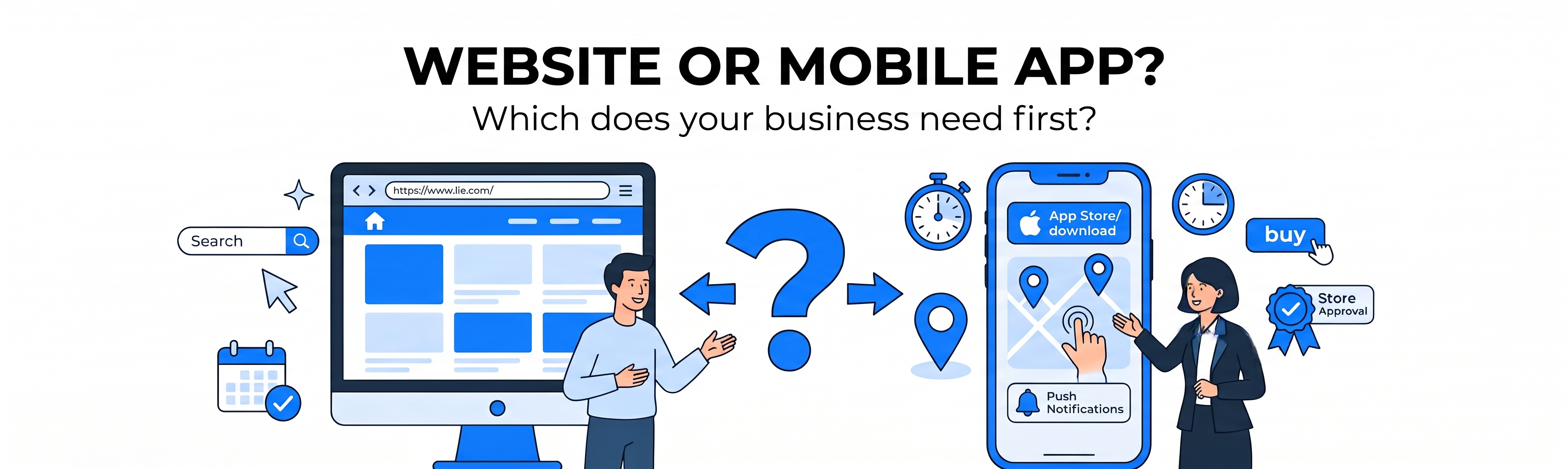
If you’re deciding between a website or mobile app first, you’re really deciding where your next ₹5 lakh, or ₹50 lakh, goes. Get it right and customers find you, trust you, and buy. Get it wrong and you spend months building something almost nobody opens.
Our position is simple: for most businesses, the website comes first. There are real exceptions, and we’ll cover them. This post gives you the reasoning, a quick way to check which side you fall on, and the mistakes we see most often.
Why the Website Usually Comes First
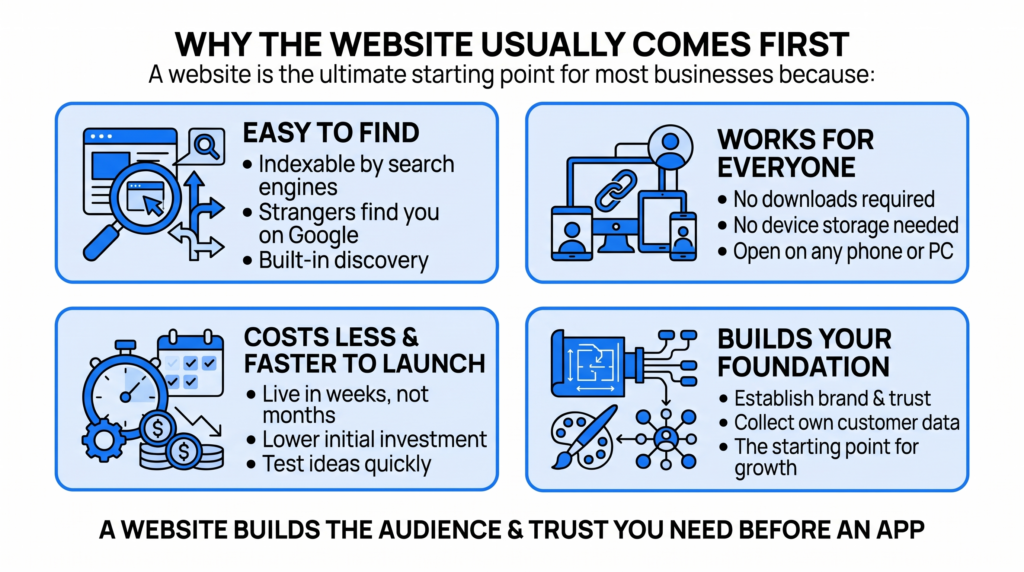
A website is the only digital asset where strangers can find you without already knowing you exist. Someone searches “dental clinic near me” or “bulk packaging supplier,” lands on a page, and decides whether to contact you. Nobody searches Google for an app they haven’t heard of yet.
Here’s what a website does that an app can’t do early on:
- It gets found. Search engines index web pages. An app sitting in a store listing gets only a fraction of that discovery.
- It works for everyone. No download, no storage space, no update. A link opens on any phone, tablet, or laptop.
- It costs less to test an idea. A focused business website can go live in weeks. A polished app on both iOS and Android takes months.
- It builds your foundation. Your brand, messaging, and customer data all start here.
When a Mobile App Should Come First
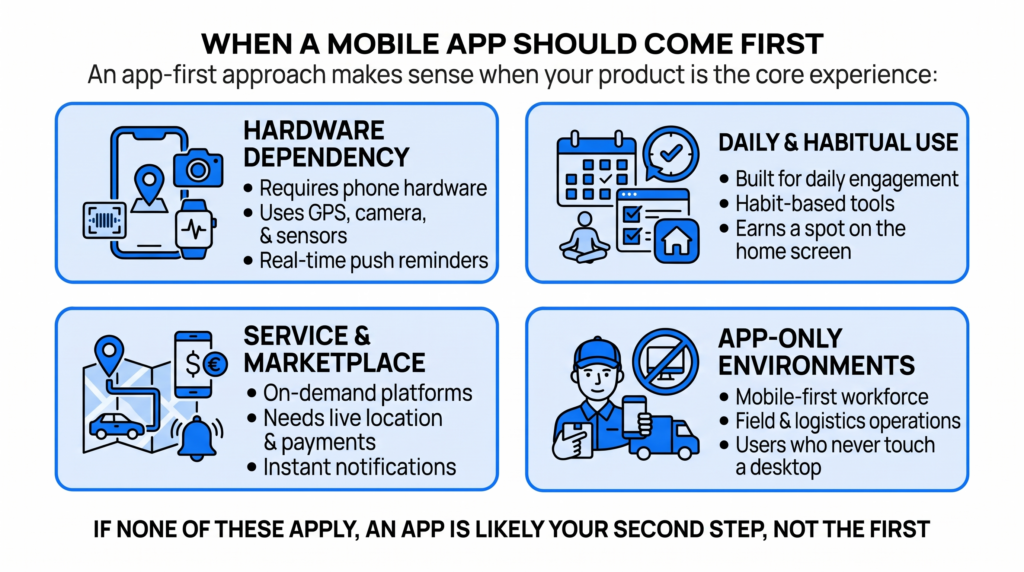
Apps win when the product itself is the app. If your business only works as a repeated, in-the-hand experience, a website alone won’t carry it.
An app-first approach makes sense when:
- Your product depends on phone hardware. Think GPS tracking, camera scanning, or push-based reminders like a delivery rider app or a fitness tracker.
- Customers will use it daily. A habit-based product such as a meditation, language-learning, or expense-tracking tool earns its home-screen spot.
- You’re building a marketplace or service platform. A ride booking or on-demand home services startup needs real-time location, notifications, and in-app payments from day one.
- Your users are already in an app-only environment. Some field teams or logistics operations never touch a desktop.
If none of these describe you, an app is likely a second step, not a first one.
Website vs. Mobile App: A Side-by-Side Comparison
| Factor | Website | Mobile App |
| Typical build time | 3 to 8 weeks | 3 to 6+ months |
| Discovery | Search engines, social, ads | App stores, referrals, paid installs |
| Cost to start | Lower | Considerably higher, especially for iOS and Android |
| Updates | Instant, you control them | Needs store approval and user updates |
| Best for | Credibility, lead generation, sales | Repeat use, hardware features, loyalty |
The pattern is clear: a website is cheaper, faster, and easier to find. An app is deeper, but only for people who’ve already decided to care about you.
What Does Each Option Cost Your Business Beyond the Build?
The build cost is only the start. A website needs hosting, content, and ongoing SEO. An app needs all of that, plus separate maintenance for iOS and Android, store fees, and updates every time a phone operating system changes.
Take an example: a local home-tutoring business wants to attract parents. A website with course pages, reviews, and a booking form can start bringing in enquiries within weeks through Google. An app for the same business would sit unused until parents had a reason to download it. The tutor would spend months building before getting a single lead.
Can You Just Build a Responsive Website Instead of an App?
Often, yes. A well-built, mobile-friendly site can behave almost like an app. It can load fast, accept payments, send enquiries, and even be saved to a phone’s home screen as a progressive web app (a website that behaves like an installed app).
This is a smart middle path. You get most of the mobile experience at a fraction of the cost, and you learn what your customers actually do before committing to a full native app.
A Quick Checklist: Which One Do You Need First?
Answer these honestly:
- Do new customers need to find me through Google? If yes, build a website first.
- Does my core product need phone hardware or real-time notifications to function? If yes, consider an app first.
- Will customers return daily or weekly? If not, an app will rarely earn its place.
- Do I have a proven audience I can push to download? If not, an app launch will struggle.
- Is my budget under what a good app costs to build and maintain? If so, start with a website.
If you answered “website” to three or more, that’s your answer.
The Mistake We See Most Often
The most common mistake is building an app because it sounds impressive. Founders see competitors with apps and assume they need one too. Months later, the app has a few hundred downloads and no clear way to grow.
We’d rather tell you to wait. A strong website brings in the first customers, shows you how they behave, and gives you real data. Then if an app makes sense, you build it knowing what features people actually want. That’s a smarter use of money than guessing.
Conclusion
For most businesses, the website comes first, because it earns trust, gets found, and costs less to learn from. Build an app first only when your product truly depends on being on the phone. Either way, the smartest move is a plan based on your customers and your budget, not on what competitors happen to be doing.
Not sure which route fits your business? Book a free consult with the Nuclay team, and we’ll tell you honestly whether you need a website, an app, or both, and in what order.
Website or Mobile App: Which One First?
Don’t waste budget guessing. Book a free consult with Nuclay to find the right roadmap for your business stage.
Book Your Free ConsultFrequently Asked Questions (FAQ)
Is a website cheaper than a mobile app?
Yes. A business website typically costs far less to build and maintain than a mobile app, especially because an app often needs separate versions for iOS and Android plus ongoing updates.
Do I need both a website and a mobile app for my business?
Not always. Many small and mid-sized businesses succeed with only a good website. You need both when you have a product people use repeatedly, or when mobile features like push notifications and GPS are central to your service.
Can a mobile-friendly website replace a mobile app?
For many businesses, yes. A responsive website or progressive web app can handle bookings, payments, and enquiries without any download. It falls short only when you need deep device features or constant background activity.
How long does it take to build a website compared to a mobile app?
A focused business website usually takes a few weeks, while a full mobile app usually takes several months. The difference grows once you add custom features, two platforms, and store approval.