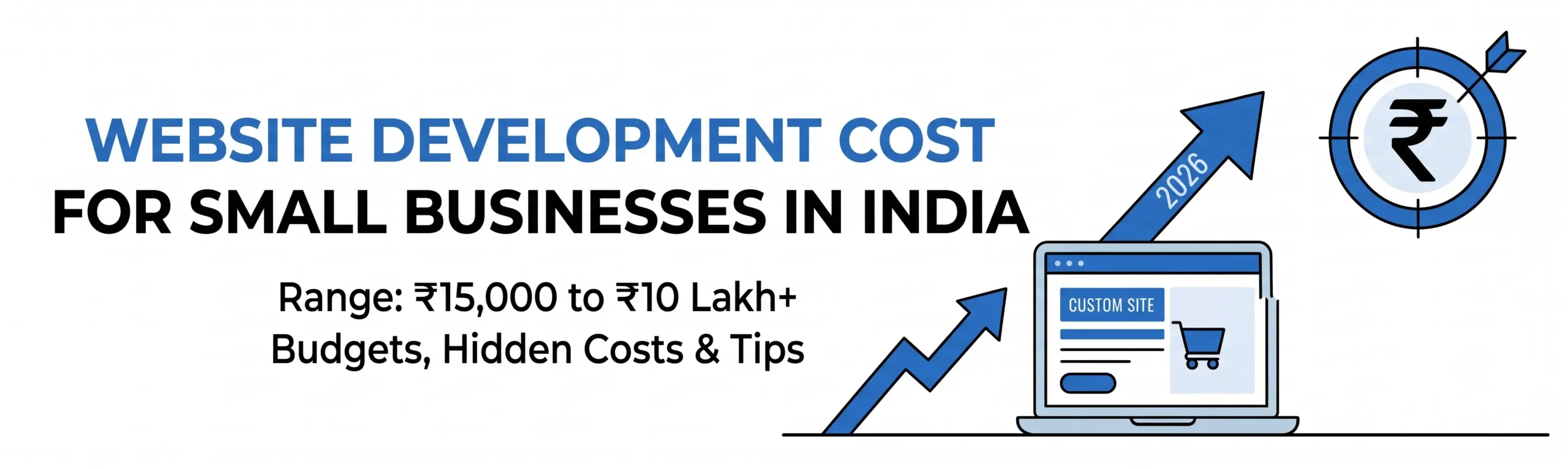
Ask five agencies what a website costs and you’ll get five quotes: ₹12,000, ₹60,000, ₹2 lakh, “it depends,” and one that never replies. The spread isn’t random. Each quote is pricing a different product, and most of the time nobody has told you which one.
This guide breaks down the website development cost for a small business in India by type of site, what each price level includes, and where the extra bills hide. You’ll leave with a realistic budget range and a set of questions for comparing quotes on equal terms.
Our stance: the right budget isn’t the lowest or the highest. It’s the one matched to the job your website has to do for your revenue.
How Much Does a Small Business Website Cost in India?
Here are indicative ranges for 2026. Actual quotes vary by city, agency, and scope.
| Type of Website | Typical One-Time Cost | Best For |
|---|---|---|
| Template-based site (DIY builder or lightly customized) |
₹10,000 – ₹40,000 | Freelancers, new businesses testing an idea |
| Custom business website Most Common (5-10 pages, WordPress or similar) |
₹40,000 – ₹1,50,000 | Clinics, consultants, local service businesses, B2B firms |
| E-commerce store (catalogue, payments, shipping) |
₹1,00,000 – ₹4,00,000 | Businesses selling 20+ products online |
| Custom web app or portal (logins, dashboards, bookings) |
₹3,00,000 – ₹10,00,000+ | Businesses whose website is the product |
What Actually Drives the Price?
Six factors move a quote up or down. Knowing them lets you cut cost where it doesn’t hurt.
- Number of pages. Every page needs design, copy, and testing. A 6-page site and a 30-page site are different projects.
- Design approach. A customized template is faster and cheaper. A fully custom design built around your brand costs more, but it doesn’t look like everyone else’s.
- Functionality. A contact form is cheap. Online payments, booking systems, and multi-language support are not.
- Content. Who writes the copy and shoots the photos? If the agency does it, it’s a line item. If you do it, it’s a delay.
- Integrations. Connecting your site to a CRM, WhatsApp, a payment gateway like Razorpay, or Salesforce adds development hours.
- Who builds it. A freelancer, a small studio, and a full-service agency price the same work very differently, and offer different levels of accountability.
Template or Custom: Which One Should You Pay For?
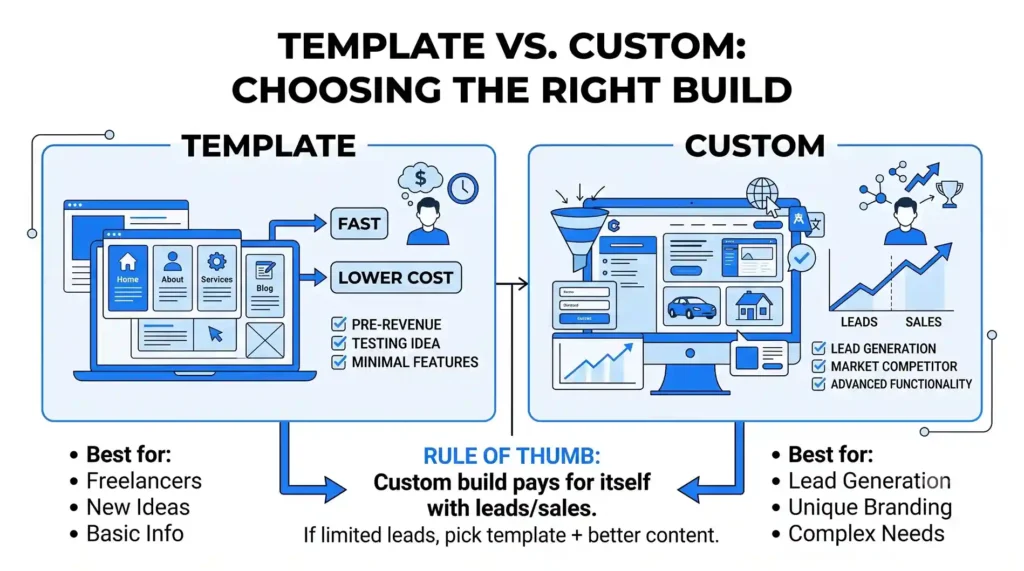
Plenty of agencies push custom builds because they’re more profitable. Plenty of budget-conscious owners pick templates and regret it a year later. Neither default is right.
Choose a template-based build if you’re pre-revenue, your offer might still change, or you mainly need a credible online presence and a way for people to contact you.
Choose custom if your website is a primary source of leads, you compete in a crowded market where looking identical to rivals costs you trust, or you need functionality that templates can’t handle.
Our rule of thumb: if your site is expected to bring in more than a handful of leads or sales every month, custom design and proper SEO setup usually pay for themselves within the first year. If it won’t, save the money and put it into a template plus better content.
The Costs Nobody Puts in the First Quote
The development quote is rarely the total. Budget for these from day one:
- Domain: ₹700 – ₹1,500 per year for a .com or .in
- Hosting: ₹3,000 – ₹25,000 per year, depending on traffic and whether it’s shared or managed
- SSL certificate: free with many hosts, ₹2,000+ if bought separately
- Premium plugins and tools: ₹5,000 – ₹30,000 per year for forms, security, backups, and SEO tools
- Maintenance: ₹2,000 – ₹10,000 per month for updates, security patches, backups, and small edits
- Content and photography: ₹10,000 – ₹50,000+ if you don’t have your own
- SEO: a proper build includes on-page basics like page structure, speed, and metadata. Ongoing SEO to actually rank is a separate monthly cost.
A realistic first-year total is usually the development cost plus 15-30%. On an ₹80,000 site, that’s ₹12,000 – ₹24,000 in running costs.
A Worked Example: Budgeting for a Service Business
Let’s run the numbers for a typical scenario: a physiotherapy clinic that wants a 7-page website (Home, About, Services, Team, Blog, Contact, Appointment Booking) with WhatsApp click-to-chat and Google Business Profile integration.
- Design and development: ₹80,000
- Copywriting and photography: ₹20,000
- Domain, hosting, and SSL (year one): ₹8,000
- Basic on-page SEO setup: included in a good build
- Maintenance plan: ₹3,000 per month, or ₹36,000 per year
That comes to roughly ₹1.44 lakh in year one, including maintenance.
Now the return. Suppose the site brings in 10 new patients a month, and each patient spends an average of ₹4,000 across a treatment plan. That’s ₹40,000 a month, or ₹4.8 lakh a year. The site pays for itself in about four months.
The numbers here are illustrative, but the method works for any business. Estimate what one new customer is worth, estimate how many the site can realistically bring in, and compare that to the cost. If the math doesn’t work at a conservative estimate, shrink the scope. If it works easily, don’t under-invest.
How to Compare Quotes Properly
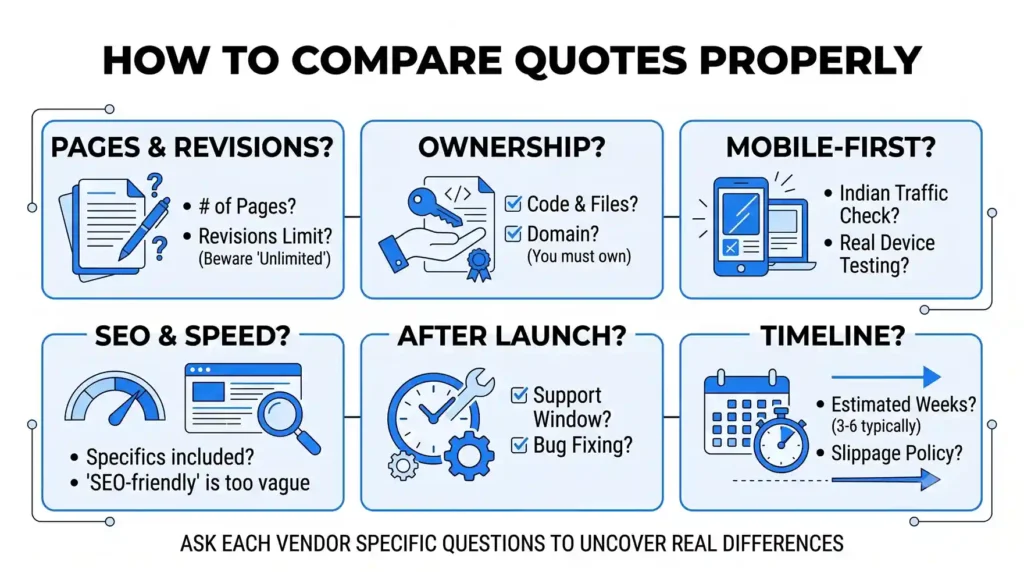
Two quotes for “a business website” are almost never the same product. Ask each vendor:
- How many pages and revisions are included? Unlimited revisions is a red flag, and so is “one round only.”
- Do I own the code, design files, and domain? You should, without exception.
- Is it mobile-first and tested on real devices? Most Indian web traffic comes from phones, so a site that only looks good on a laptop is half a site.
- What’s included for SEO and speed? Ask for specifics. “SEO-friendly” isn’t a specification.
- What happens after launch? Is there a support window, and who fixes bugs?
- What’s the timeline, and what happens if it slips? A typical business site takes 3-6 weeks.
When the Cheapest Quote Costs the Most
The pattern is common: a business pays ₹15,000 for a site, it loads slowly, doesn’t show up on Google, breaks on some phones, and gets rebuilt within 18 months. The total spend ends up higher than doing it properly once.
Cheap isn’t automatically bad. Cheap with no clear scope, no ownership of your assets, and no support is. Spend where it affects lead generation (design, speed, structure, copy) and save on things that don’t (unneeded features, heavy animations, filler pages).
To Sum it Up
A small business website in India can cost anywhere from ₹15,000 to ₹5 lakh+, and the right number depends on what the site needs to do for you. Decide on the outcome first (leads, sales, credibility), pick the build type that serves it, and budget for the running costs the first quote leaves out.
Not sure which range fits your business? Get a custom quote from Nuclay. Tell us what you need and we’ll send back a scoped, itemised estimate with no vague line items.
Need a Clear Website Quote?
Get an itemized estimate tailored to your exact budget and goals.
Get Your QuoteFrequently Asked Questions (FAQ)
Do I pay monthly or one-time for website development?
Development is usually a one-time fee, often split into milestone payments. Hosting, domain renewal, and maintenance are recurring. Some agencies offer a monthly subscription model, so check what happens to your site if you stop paying.
How long does it take to build a small business website?
A standard 5-10 page site typically takes 3-6 weeks. E-commerce stores take 6-10 weeks, and custom apps take longer. Most delays come from late content and slow feedback, not from development itself.
Should I hire a freelancer or an agency?
A good freelancer works well for small, well-defined projects. An agency makes more sense when you need design, development, SEO, and ongoing support from one accountable team. Check portfolios and speak to past clients either way.
Will my website rank on Google automatically once it’s built?
No. A well-built site is set up to rank, but it still needs quality content, backlinks, and time. Budget for ongoing SEO if search traffic is a goal.